Quick answer
Murano glass is glass blown and shaped by hand on the island of Murano, in the Venetian lagoon, where Venice’s furnaces have been concentrated since 1291. Real pieces carry the Vetro Artistico® Murano sticker with a producer code, a serial number and a scannable code. On licensed producers’ own shops, a murrina pendant costs €40 to €75 and a blown vase €220 to €417; a furnace demonstration costs €5 to €29.
Prices, opening times and rules checked on 13 November 2026.
To reach the island, take vaporetto line 12 from Fondamente Nove (9 minutes) or line 3 from the train station: our Murano and Burano guide has the boats, the day plans and the island’s other sights. This guide is about the glass itself.
What makes Murano glass special
Venice has made glass for over a thousand years: the first document naming a Venetian glassmaker, a certain Domenico, dates from 982. By the 13th century the furnaces had moved to Murano, and in 1291 the Republic ordered any glassworks built in the city itself destroyed. Murano has been the glass island ever since, and some of its glassmaking families have worked there without a break from the Middle Ages to today.
The material matters too. Around the middle of the 15th century Angelo Barovier, a Murano glassmaker, produced cristallo, a clear, colorless glass. It is a soda glass, which stays soft long enough for a master to pull, twist and blow it into thin, complex shapes by hand. Bohemian potash glass and English lead crystal, which came later, behave differently at the furnace.
Murano glass techniques you will see in the shops
Most of what you see on Murano comes from a handful of techniques. Knowing the names helps you read labels and ask the right questions.
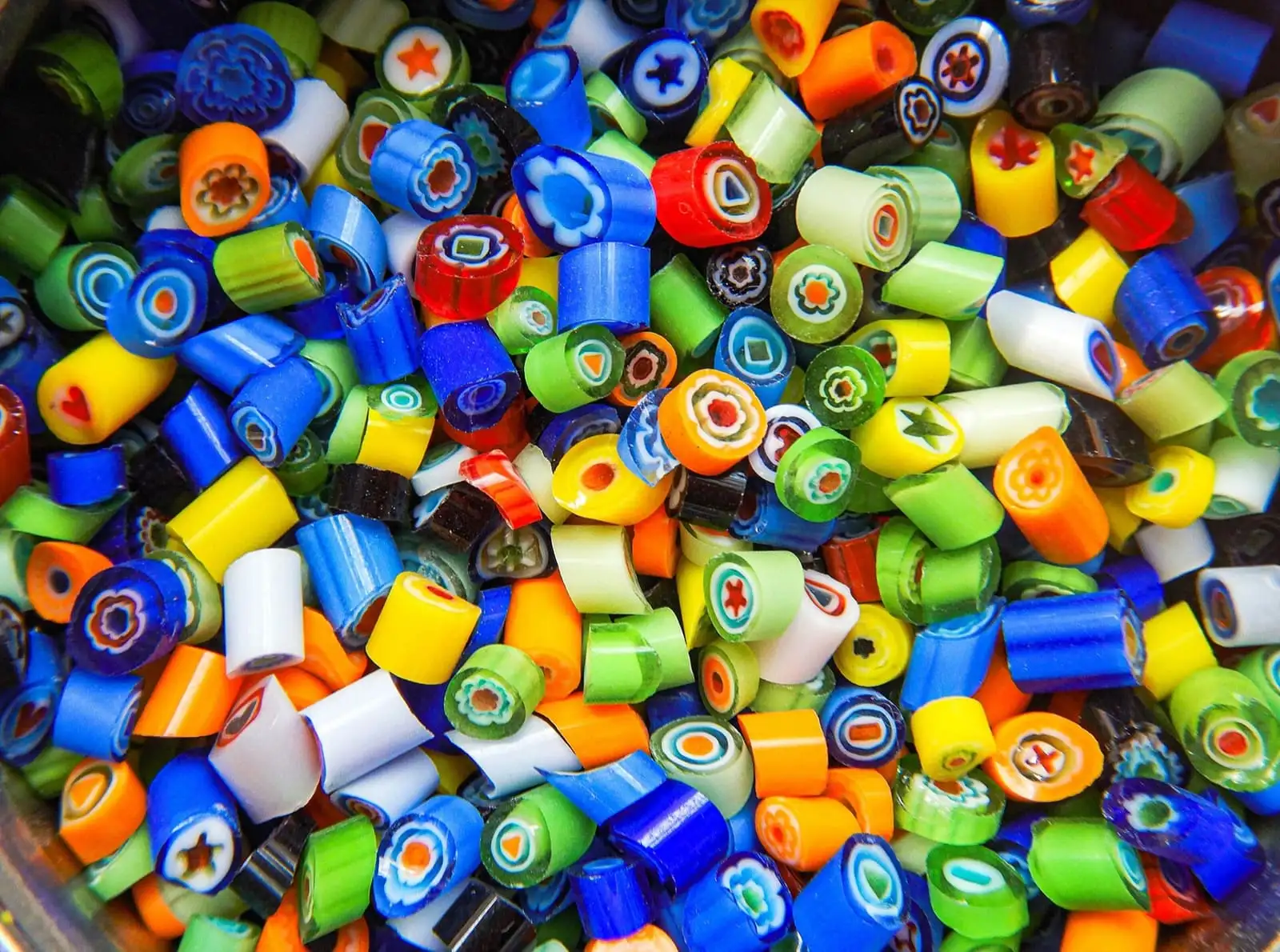

Slices of millefiori cane, the building blocks of murrina jewelry and mosaic glass.
| Technique | What it looks like | On Murano since |
|---|---|---|
| Cristallo | Clear, colorless, very thin glass | Mid-15th century |
| Lattimo | Opaque white glass that looks like porcelain | Mid-15th century |
| Calcedonio | Dark glass with veins of color, like agate | Mid-15th century |
| Filigrana | White or colored threads inside clear glass, as a net (reticello) or twisted spirals (zanfirico) | First half of the 16th century |
| Avventurina | Glass full of tiny glittering copper crystals | First half of the 17th century |
| Murrine and millefiori | Slices of patterned glass canes fused into a mosaic, often like small flowers | Ancient technique, revived on Murano in the 1870s |
| Sommerso | Thick layers of different colors, one inside the other | Popular from the 1930s |
Avventurina got its name from avventura, adventure: even for an expert, the result of the long firing was never certain. Beads and small figurines are made a lume, shaped at a torch flame from solid glass canes.
How to tell if Murano glass is real
Shops all over Venice sell colorful glass, and not all of it was made on Murano. The only label that certifies origin is the Vetro Artistico® Murano trademark, a collective mark created by a Veneto regional law in 1994 and managed by the Consorzio Promovetro Murano. Only companies that make art glass on Murano can apply, and today 35 producers hold the license.
What to check on the piece:
- The sticker. Licensed producers put an adhesive sticker with the trademark logo on each piece. It is red for primary working, the glass shaped hot at the furnace, and blue for secondary working.
- The producer code. The number at the top of the sticker identifies the company that made it.
- The serial number and data matrix code. Since 2016 every sticker carries both, a kind of ID card for that one piece. Scan the code with any phone app that reads data matrix codes, or enter the numbers on the trademark website. If you are still unsure, email the Consorzio at [email protected].
- The shop. An authorized shop must have at least 80% of its stock carrying the trademark, and it displays a window sticker with a number (V07, V20 and so on) that you can match against the official list.
A piece without the sticker is not automatically fake, because not every Murano furnace holds the license. In that case, ask who made the piece and where, get the furnace’s name on the receipt, and check that the furnace is on Murano.
A name is not proof either. Original Murano Glass, or OMG, is the name of one Murano glassworks, Original Murano Glass s.n.c. on Fondamenta San Giovanni dei Battuti, which runs one of the demonstrations below. It is a company, not a certification: the only mark of origin is Vetro Artistico® Murano, managed by the Consorzio Promovetro Murano.
How much does Murano glass cost
Prices depend on the technique, the size and above all on how many hours a master spent on the piece. The table shows prices listed on 13 November 2026, tax included, on the official sites of three licensed Murano producers: Nadia Vianello MurrineMap, which makes murrina jewelry, the glassworks Yalos MuranoMap and Fornace MianMap, known for its chandeliers.
| Piece | Price | Where |
|---|---|---|
| Murrina millefiori pendant | €40 to €75 | Nadia Vianello Murrine |
| Murrina drop earrings | €65 | Nadia Vianello Murrine |
| Drinking glasses, set of 2 to 6 | €104 to €201 per set | Yalos Murano |
| Blown bowl | €70 to €324, by size | Yalos Murano |
| Blown vase | €220 to €417 | Yalos Murano |
| Chandelier | On request | Fornace Mian |
Use these figures as a yardstick in the shops. Chandeliers and one-off sculptures are quoted piece by piece: get the price, the packing and the delivery terms in writing.
Where to buy Murano glass in Venice
You do not have to go to Murano to buy from a Murano furnace. The Consorzio’s list of authorized shops includes several in the historic city:
- MuranoVitrumMap, Frezzeria, San Marco 1229, in the shopping streets behind Piazza San Marco: sculptures, lighting, objects and jewelry (shop V07).
- SA.MI.Map, Campo San Filippo e Giacomo, Castello 4293/A, east of St. Mark’s Basilica: vases, sculptures, lighting, goblets and jewelry (shop V03).
- La FornasottaMap, Santa Croce 557/a: objects from the La Fornasotta furnace (shop V35).
On Murano, the furnaces’ own showrooms line Fondamenta dei Vetrai and Fondamenta San Giovanni dei Battuti. Buying at the furnace lets you see the work first and ask the maker about shipping.
Watching a furnace demonstration
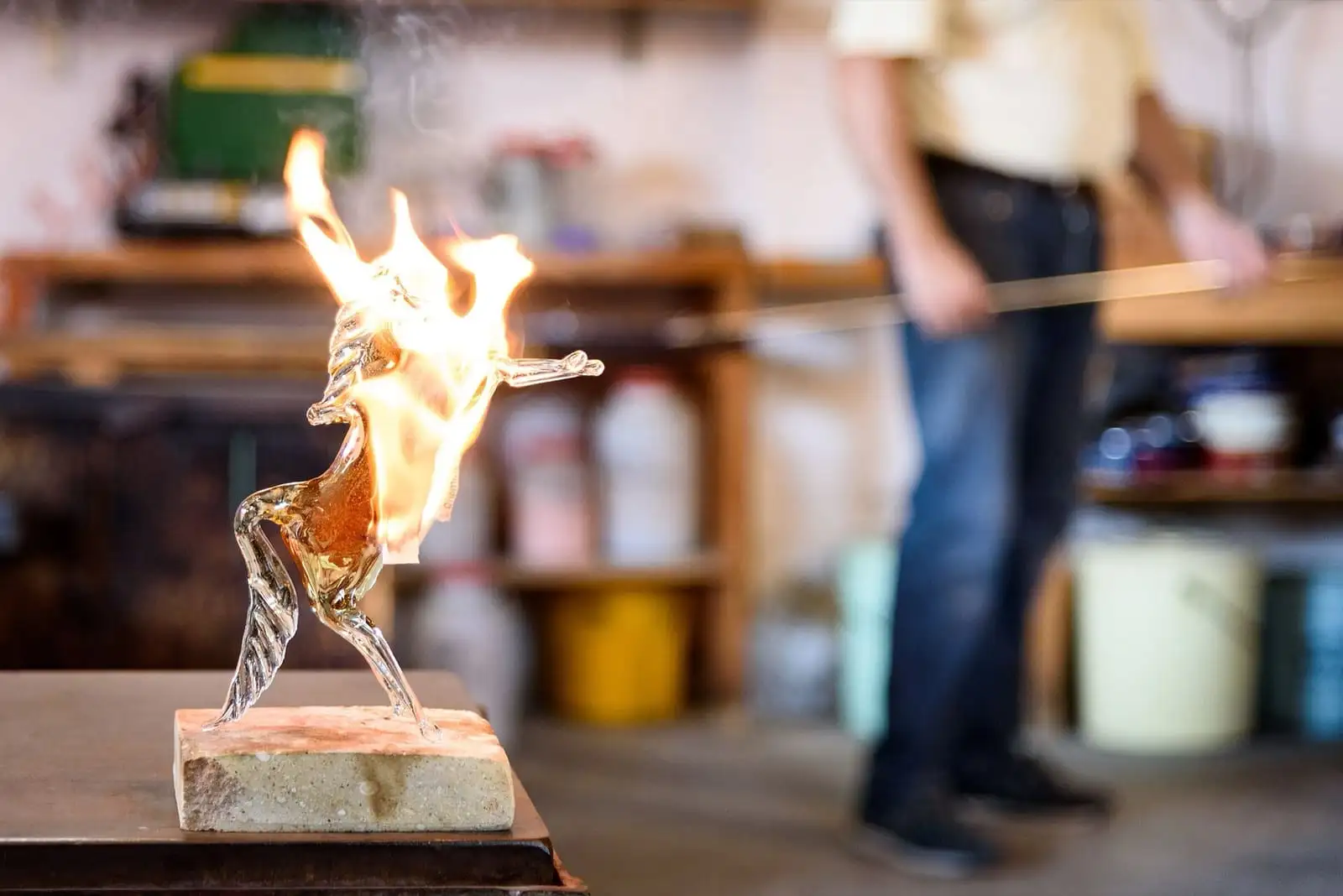
A demonstration is the best way to understand what you are paying for: a master turns a glowing gather of glass into a vase or a rearing horse in a few minutes. Most end in the showroom, where you are free to look and leave. Of the four below, Fornace Mian lets you walk in, while Original Murano Glass (OMG)Map, Vetreria Artistica ColleoniMap and Wave Murano GlassMap sell timed visits.
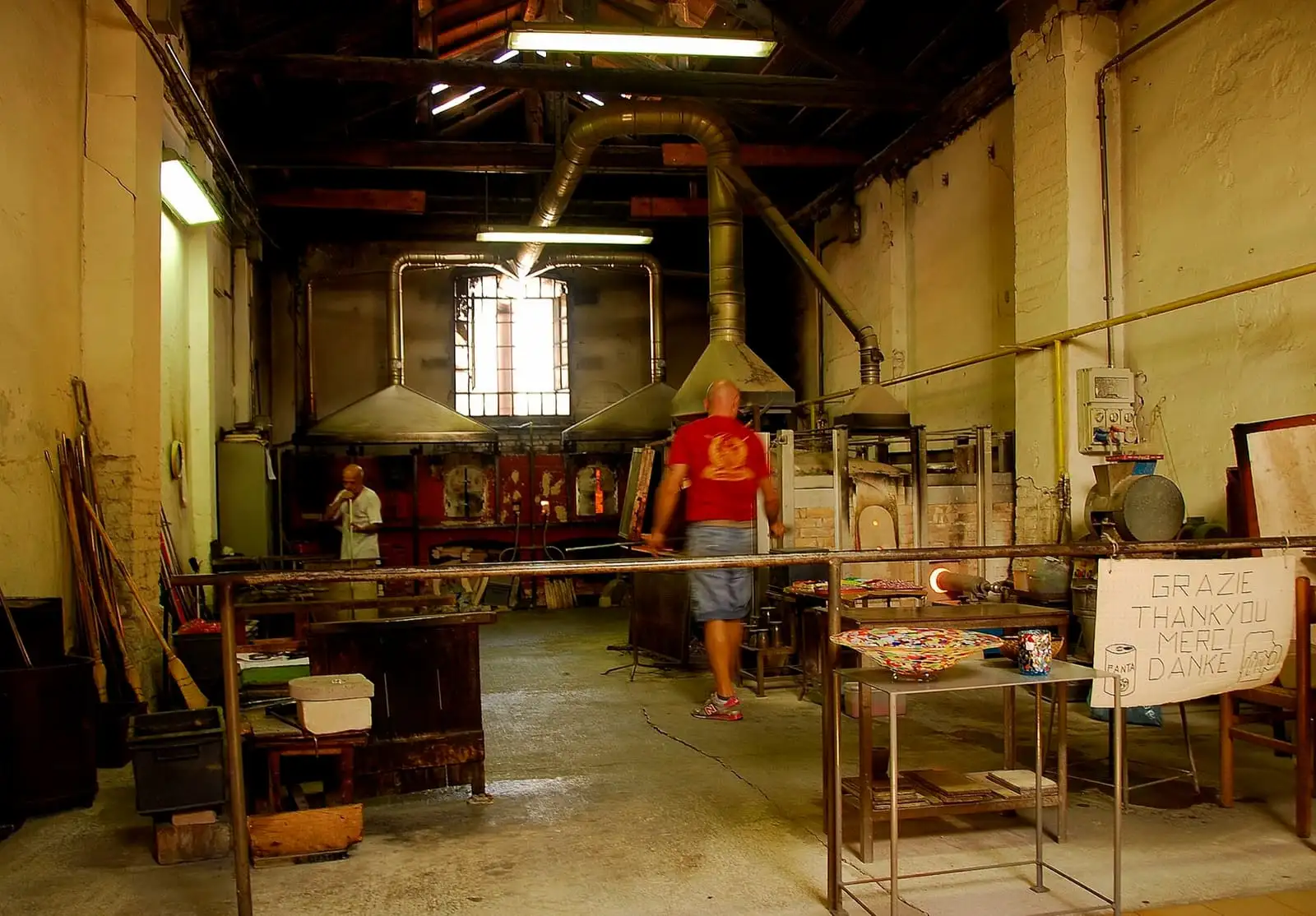

A Murano furnace set up for visitors, with the working area behind a rail.
| Furnace | What you see | Price | Booking |
|---|---|---|---|
| Fornace Mian | Staff take you into the working area | No fee published | Open daily 9:30am to 5pm |
| Original Murano Glass (OMG) | Blown vase and sculpted horse, under 10 minutes | €5, under 14 free | Required, every half hour 9:30am to 3:30pm Book |
| Vetreria Colleoni | Blowing and sculpting demonstration, 20 minutes | €10, with a €10 shop credit | Online Book |
| Wave Murano Glass | Guided tour of the whole factory, 45 to 60 minutes, max 8 people | From €29 | Online, often fully booked a month ahead Book |
What to expect:
- The short shows at OMG and Colleoni are quick and work well with children. OMG gives the ticket price back as a coupon on purchases over €90, and Colleoni as a €10 credit. At OMG you watch from tiered seats, so you are not right next to the master.
- The Wave tour is the one to pick if you want to understand the process: an English-speaking guide takes a small group through the factory while the masters work. It is hot near the furnaces and the route is not wheelchair accessible. Book it on Wave’s own site, and check in at the shop at Fondamenta da Mula 152.
- The showroom. Nobody can make you buy. If you are tempted, check the sticker, ask for the producer’s name on the receipt and get the shipping price before you agree.
You can book the short shows here:
The Murano Glass Museum
The Glass MuseumMap, founded in 1861 in the old palace of the bishops of Torcello, tells the whole story in order: Roman glass on the ground floor, then cristallo, filigree and diamond-point engraving from Murano’s golden age, 18th-century chandeliers, Venetian beads, murrine and the 20th-century design pieces. It is the place to see what a technique looks like at its best before you shop.
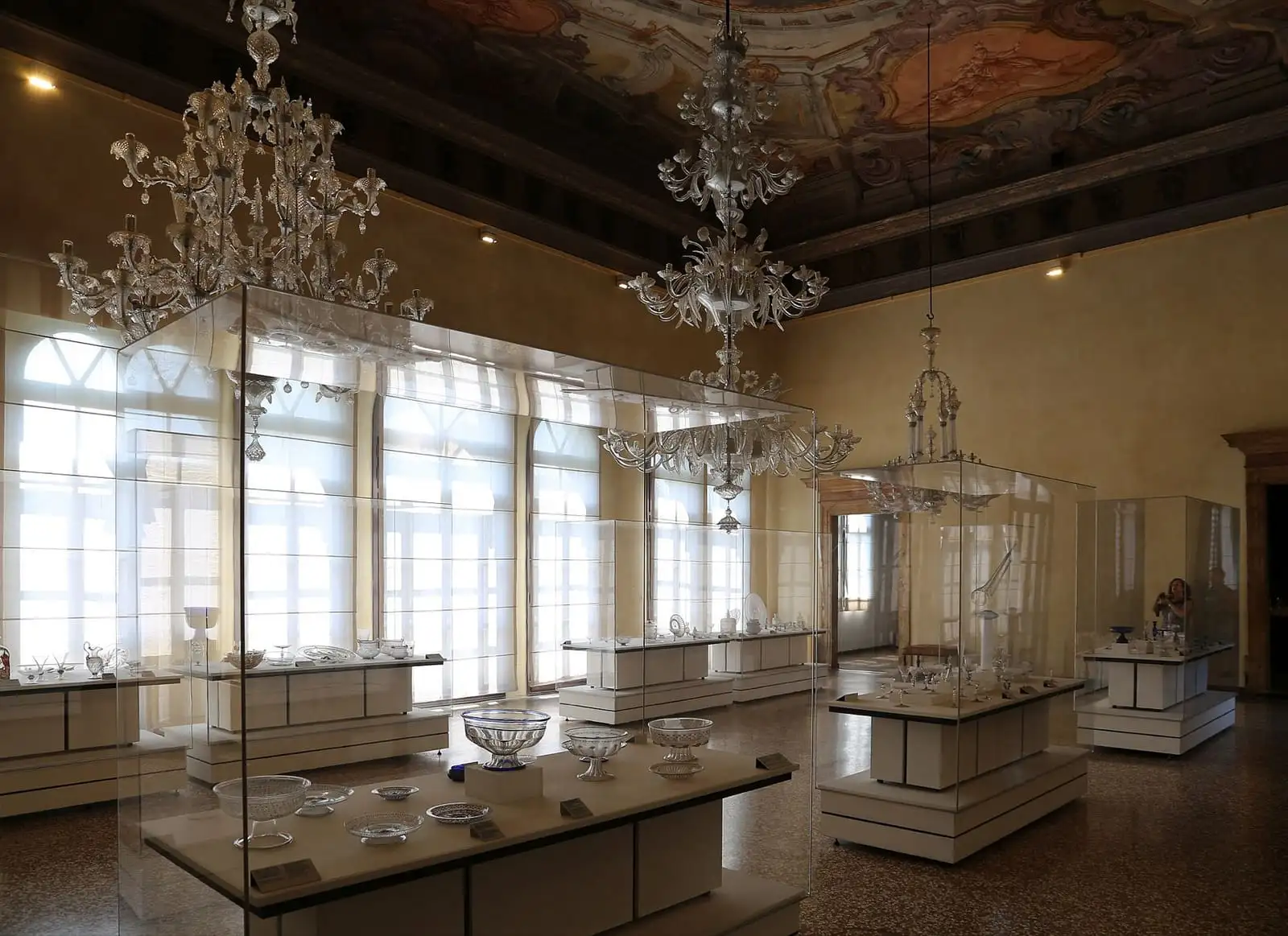

The main hall of the Glass Museum in Palazzo Giustinian, with its chandeliers.
Two things are new. Since 2025 a section on the 19th century, from crisis to revival, has been open in the former Conterie complex, with several hundred pieces, many of them never shown before. Until 30 March 2027 the museum also hosts BABEL, about twenty gold-leaf engraved glass works by Marco Toso Borella. In winter (1 November to 31 March) it opens 10am to 5pm, with last entry at 4pm; tickets cost €15, and the museum is also in the Venice Museum Pass. The cheaper island combination ticket is explained in our Murano and Burano guide.
Getting Murano glass home to the US
Carry it if you can. As a returning US resident who has been abroad at least 48 hours, you have an $800 duty-free personal exemption for goods you bring back with you. Ask the shop to pack fragile pieces for your carry-on.
If the shop ships it. A shipped piece does not count toward your personal exemption: it enters the US as a separate import. Since 29 August 2025 the US has suspended the duty-free treatment of low-value shipments from every country, so a parcel of any value can owe duty, taxes and fees, often collected by the carrier before delivery. Before you pay, ask whether the price includes delivery and US duties, which carrier is used, and whether the piece is insured against breakage. Gifts mailed home are duty free only up to $100 per recipient per day, and they do not need to be declared when you return.
Claim back the Italian VAT. Visitors who live outside the EU can get a refund of the Italian VAT on goods for personal use when a single invoice is over €70. The shop issues an electronic tax-free invoice with your passport details and a request code; the goods must leave the EU by the end of the third month after the purchase. Customs validates the invoice digitally where you leave the EU (on a through ticket, at your departure airport in Italy). The refund comes from the shop or a tax-free company, minus their fee, never from customs. Rules and procedure are on the Italian customs agency’s site.
The Venice Glass Week
Each September Venice holds The Venice Glass Week, a festival dedicated to glass across Venice, Mestre and Murano. The 2027 edition runs from 11 to 19 September 2027; the program appears on the festival’s site.
Plan the rest of your trip
Murano fits easily into a half day, and with Burano it makes a full one: our Murano and Burano guide has two timed plans. If you are still shaping your stay, see how many days in Venice and our list of things to do in Venice.
Frequently asked questions
What is so special about Murano glass?
It is handmade on one small island in the Venetian lagoon, where furnaces have been concentrated since 1291. Venetian glass is a soda glass that stays workable for a long time, which lets a master shape it by hand into thin goblets, filigree and millefiori that took centuries to perfect.
How can you tell if glass is real Murano glass?
Look for the Vetro Artistico Murano sticker. It shows the producer's code at the top and, since 2016, a serial number and a data matrix code you can scan to check that single piece. Shops authorized by the Consorzio show a numbered window sticker.
Is Murano glass expensive?
Small pieces are not. On the official shops of licensed Murano producers, murrina pendants cost €40 to €75, a set of drinking glasses €104 to €201 and a blown vase €220 to €417 (prices seen on 13 November 2026). Chandeliers and one-off art pieces are priced on request.
Can you buy real Murano glass in Venice without going to Murano?
Yes. The Consorzio Promovetro lists authorized shops in San Marco, Castello and Santa Croce, where at least 80% of the stock must carry the Vetro Artistico Murano trademark. Each one shows its number on a window sticker.
Can you watch glassblowing on Murano for free?
Fornace Mian on Fondamenta dei Vetrai welcomes visitors into its furnace every day from 9:30am to 5pm and publishes no fee. The booked demonstrations cost €5 at Original Murano Glass, €10 at Vetreria Colleoni and from €29 for the small-group tour at Wave Murano Glass.
Do I pay US duty on Murano glass?
What you carry home in your luggage falls under the $800 duty-free personal exemption if you have been away at least 48 hours. A piece the shop ships to you does not use that exemption, and since 29 August 2025 shipments of any value can owe duty, so ask for a delivered price that includes US duties.
What is OMG Murano glass?
OMG stands for Original Murano Glass, a glassworks on Fondamenta San Giovanni dei Battuti on Murano that runs a €5 glassblowing show. The name belongs to a company and is not a certification; the mark that certifies Murano origin is Vetro Artistico Murano, managed by the Consorzio Promovetro Murano.