
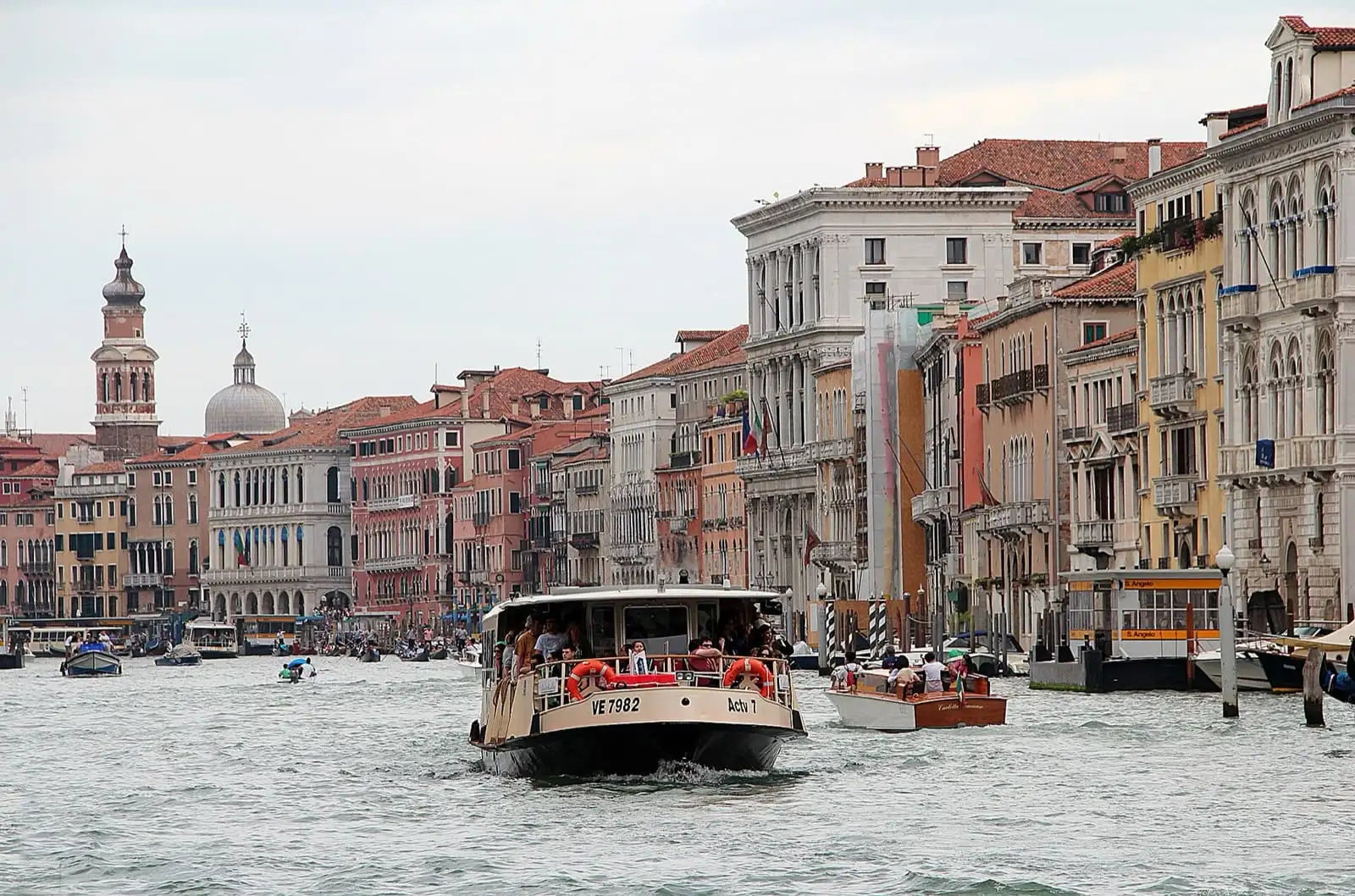
Quick answer
A Venice vaporetto ticket costs €9.50 and lasts 75 minutes; passes cost €25 for 24 hours, €35 for 48 hours, €45 for 72 hours and €65 for 7 days. Tap a contactless card on the validator before you walk onto the floating stop, and ACTV caps what you pay at the daily pass price once you take a third ride. Line 1 runs the whole Grand Canal from the train station to San Marco in about 41 minutes.
Prices and times checked on 7 November 2026, on the ACTV fares page and the winter timetable in force from 2 November 2026. For walking, water taxis, the traghetto and how to arrive, see our guide to getting around Venice.
Vaporetto tickets and passes: prices
The vaporetto is Venice’s public water bus, run by ACTV (part of the city’s transport company AVM). The same tickets and passes cover the ACTV boats in the city and the lagoon, with the exceptions listed below, plus the buses on the Lido and in Mestre.
| Ticket | Price | Rides it takes to beat single tickets | Book |
|---|---|---|---|
| Single ticket, 75 minutes | €9.50 | Venezia Unica | |
| Venezia Daily Pass, 24 hours | €25 | 3 rides (3 x €9.50 = €28.50) | See the pass |
| 2-day pass, 48 hours | €35 | 4 rides (€38) | See the pass |
| 3-day pass, 72 hours | €45 | 5 rides (€47.50) | See the pass |
| 7-day pass, 168 hours | €65 | 7 rides (€66.50) | See the pass |
| Rolling Venice 3-day pass, ages 6 to 29 | €27, plus the €6 Rolling Venice card | 4 rides, counting the card (€33 against €38) | Venezia Unica ticket office |
| Airport supplement on any 1, 2, 3 or 7-day pass | €7 one way, €13 return | Venezia Unica, with the pass |
Fares are from the ACTV fares page. Children under 6 ride free. Every pass starts at your first validation, not on the day you buy it, and runs by the hour: a 24-hour pass validated at 3pm lasts until 3pm the next day.
A few things the price list does not spell out:
- The 75-minute ticket allows changes. You can switch boats as often as you like within 75 minutes, but you must validate again each time you board.
- The €25 daily pass also covers some trains. Bought as a ticket, the Venezia Daily Pass includes Trenitalia regional trains (R and RV) inside the city limits, which means Venezia Santa Lucia to Venezia Mestre. This does not apply when the daily price comes from tapping a bank card.
- What no pass covers: ACTV lines 16 and 19, the Casinò boat, every Alilaguna boat, and trips to and from Marco Polo Airport unless you bought the supplement.
- Rolling Venice is for anyone aged 6 to 29. Buy the €6 card at a Venezia Unica ticket office, then the €27 3-day pass with it.
How to pay: contactless, app or ticket machine
You have five ways to get a valid ticket. Contactless is the easiest for a visitor.
- Tap a bank card or phone. The validators at every stop accept contactless Visa, Mastercard, Maestro, V Pay and American Express cards, plus a card stored on your phone or watch. Each tap on the water network costs €9.50, and you do not tap out when you get off. ACTV then applies what it calls the best fare: once your taps go over €25 within 24 hours of the first one, you pay €25 and further rides in those 24 hours cost nothing. The same cap works for 48 hours (€35), 72 hours (€45) and 7 days (€65). Charges show up on your statement the next day. Details are on ACTV’s contactless page.
- AVM Venezia app. Buy single tickets and passes in the official app for iOS and Android, then activate the ticket and hold the QR code to the reader at the turnstile. Tickets bought in the app stay on that phone and cannot be moved to a card.
- WhatsApp. ACTV’s Chat&Go service sells tickets in a chat: save +39 339 990 8002 or scan the QR code posted at the stops, then pay by card or with the wallet on your phone.
- Online before you fly. Buy on veneziaunica.it, the official sales site, or through an authorized partner such as GetYourGuide. Either way you receive a booking code (PNR) that you turn into a ticket at a Venezia Unica self-service machine before your first ride.
- Machines, ticket offices and on board. Self-service machines sell tickets 24 hours a day, and Venezia Unica ticket offices sell everything, including the Rolling Venice card. If you board without a ticket, tell the crew the moment you step on: they sell the €9.50 ticket on board and take cards.
One card can pay for up to five people traveling together: tap it once per person on the same validator within 60 seconds. If an inspector checks, show the card or phone you tapped with.
How to validate and board
Vaporetto stops are floating pontoons, and you validate on land before you walk onto them. Keep your wallet away until you reach the validator: the city’s anti-pickpocket officers catch thieves at the Ferrovia stop. Hold your ticket, card or phone flat against the validator: a green light and a beep mean you are good to go; a red or yellow light means it did not work. An open turnstile does not prove that your ticket was validated, and inspectors can fine you anywhere on the stop or on board. If you are caught without a valid ticket, you pay a fine plus the full fare.
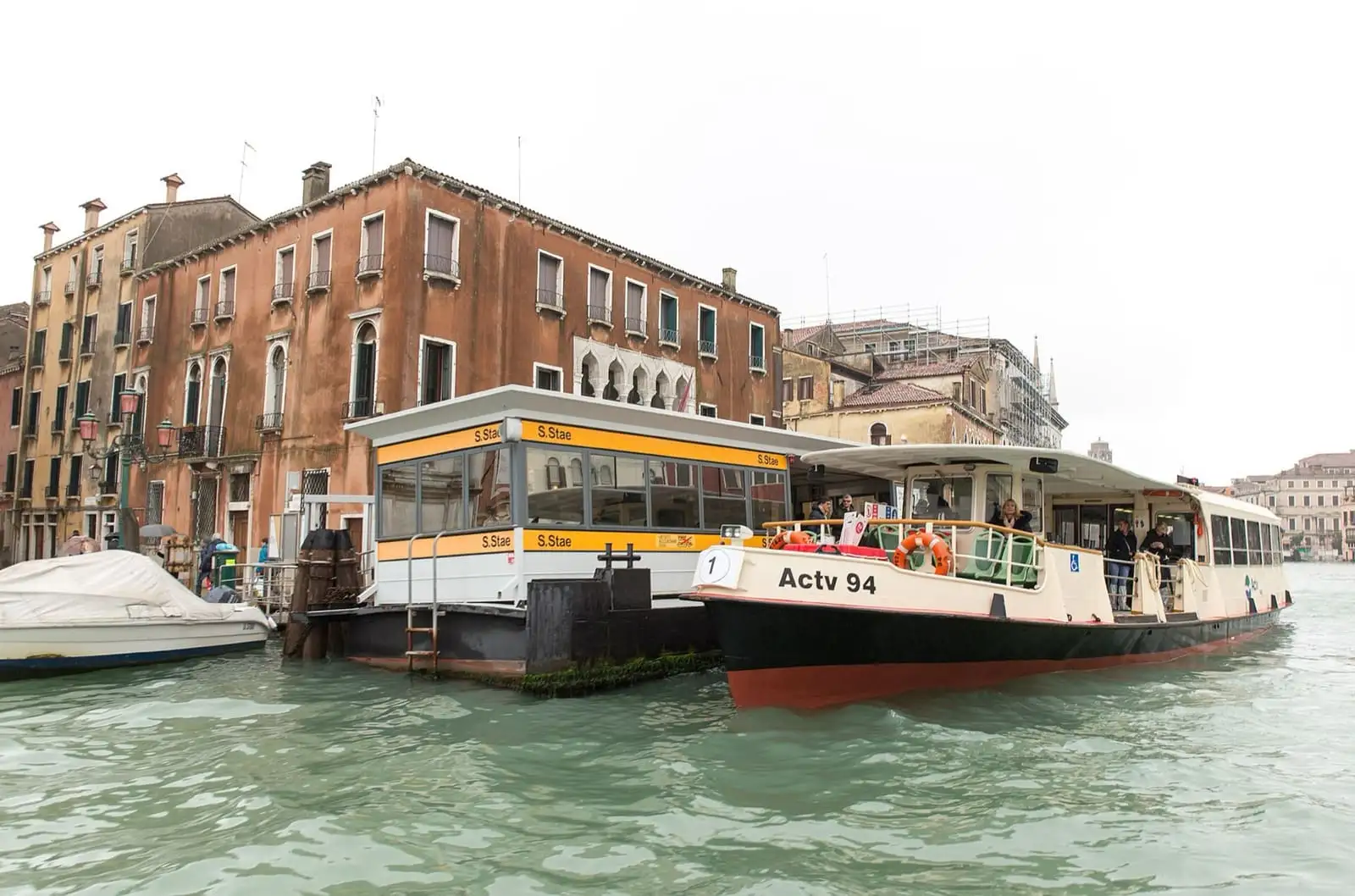

A vaporetto docking at the San Stae stop on the Grand Canal.
The big stops have several pontoons, each marked with a letter, and different lines leave from different ones. At Piazzale Roma, Ferrovia, Rialto and San Marco, check the line number and direction on each pontoon’s information panel before you validate. ACTV publishes a map of every pontoon at these stops, along with the full network map.
On board, keep bags on the floor, never on the seats, and move toward the exit as the boat approaches your stop.
Which vaporetto lines you will use
Most visitors only need four lines. Times below come from the ACTV timetable in force from 2 November 2026. To see the routes drawn out, open the ACTV network map or our map of Venice, which marks the stop nearest each sight.
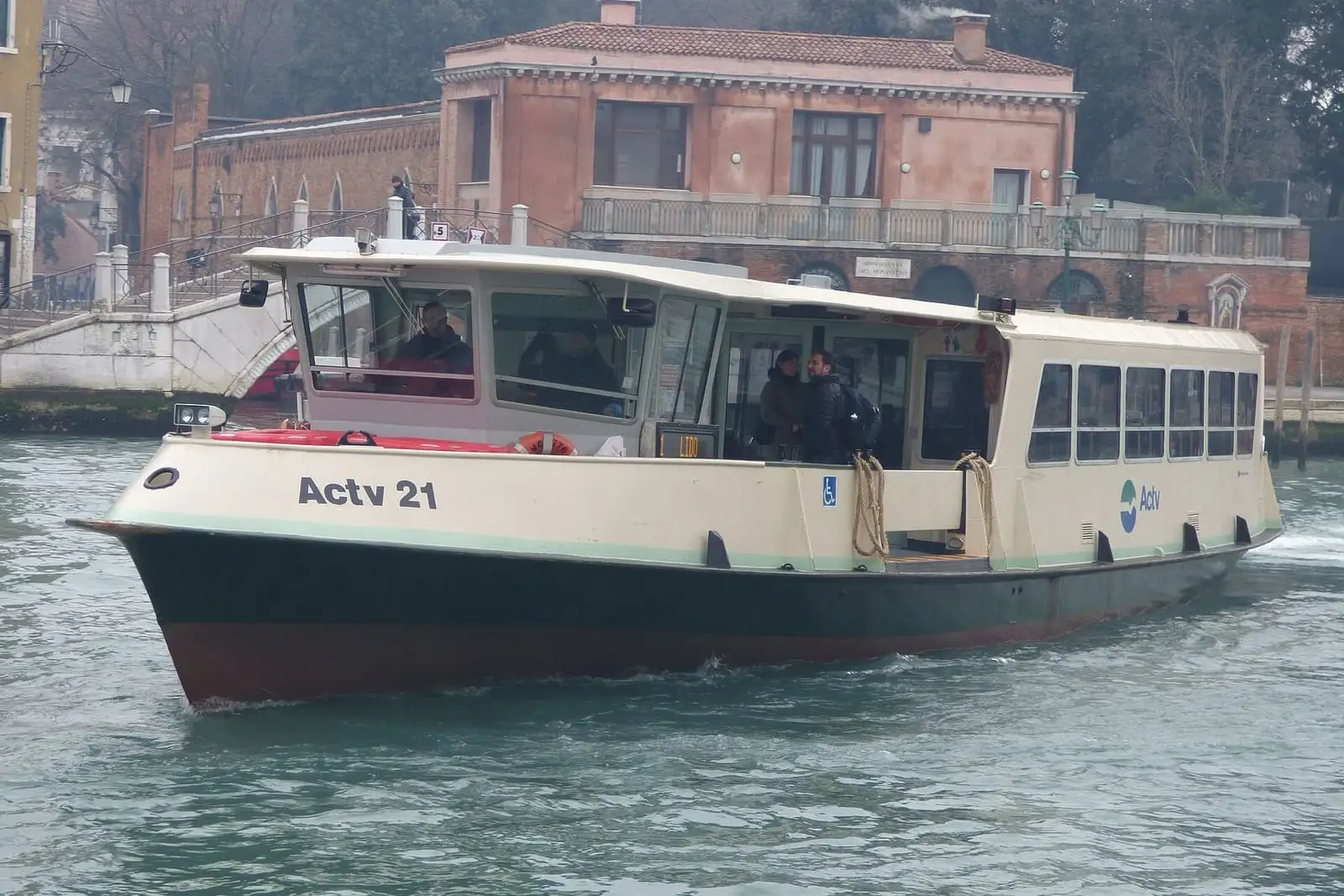

A line 1 vaporetto on the Grand Canal in front of Santa Lucia railway station.
| Line | Route | How often | Use it for |
|---|---|---|---|
| 1 | Piazzale Roma, Ferrovia, almost every Grand Canal stop, San Marco, Lido | Every 12 minutes in the day | The slow Grand Canal ride, any stop in between |
| 2 | Piazzale Roma, Ferrovia, Rialto, then Accademia and San Marco in daytime; the other way via Giudecca and San Zaccaria | Every 12 minutes | The fast trip to Rialto or San Marco |
| 3 | Piazzale Roma, Ferrovia, Murano | Every 30 minutes, 6:20am to 6:50pm | Murano straight from the station |
| 12 | Fondamente Nove, Murano Faro, Mazzorbo, Torcello (some runs), Burano | Every 30 minutes | Burano and Torcello |
Line 1: the whole Grand Canal
Line 1 stops at almost every stop on the Grand Canal, from Piazzale Roma and Ferrovia (the Santa Lucia train station) past Rialto and Accademia to San Marco Vallaresso, then along the waterfront to the Lido, where our Lido guide picks up. It takes 19 minutes from Ferrovia to Rialto, 32 minutes to Accademia and 41 minutes to San Marco. Boats run every 12 minutes during the day, then every 20 minutes in the evening, with the last departure from Piazzale Roma at 11:41pm. Ride it once to see the palaces from the water, but it is the slowest way to reach San Marco; our Grand Canal guide tells you which palace is at which stop.
Line 2: faster, with a winter catch
Line 2 skips many stops: from Ferrovia it reaches Rialto in 12 minutes and San Marco Giardinetti in 29. In the winter timetable it only continues past Rialto to San Tomà, San Samuele, Accademia and San Marco during the day, with the first arrival at San Marco Giardinetti at 9:51am and the last at 5:03pm. At other times it turns back at Rialto, so check the panel on the pontoon. On the morning of the water parade that opens the Venice Carnival, lines 1 and 2 leave the Grand Canal and go around by the Giudecca canal. In the other direction, line 2 runs from Piazzale Roma around the outside of the city, past Tronchetto and the Giudecca, to San Zaccaria in about 38 minutes.
Murano, Burano and the night boat
For Murano, line 3 leaves Piazzale Roma every 30 minutes and reaches Murano Colonna in 21 minutes. The circular lines 4.1 and 4.2 also link Murano with Fondamente Nove, Ferrovia and Piazzale Roma. For Burano, take line 12 from Fondamente Nove, on the north side of the city: boats leave every 30 minutes, stop at Murano Faro on the way and take about 40 minutes to Burano. For a full day on the islands with times and museum prices, see our Murano and Burano guide.
After about 11:30pm, the night line N takes over. It runs along the Grand Canal and the Giudecca Canal to the Lido until about 5am, every 20 to 30 minutes from Piazzale Roma.
The other lines, including the boats to Punta Sabbioni and the car ferry, are on the ACTV map. The full timetables are on the ACTV timetable page and in the AVM Venezia app. When the tide rises above 95 cm or in thick fog, ACTV changes some routes; it posts the changes on its @muoversivenezia social accounts and on the information panels at the stops.
Luggage on the vaporetto
ACTV’s general conditions of transport (updated June 2025) let each passenger with a valid ticket carry three bags free. Each bag must measure no more than 150 cm when you add length, width and height, which is about 59 inches.
- More than three bags: buy one extra ticket for every one to three extra pieces.
- Any bag over 150 cm: not allowed on board. A suitcase at the usual US airline checked-bag limit of 62 linear inches (157 cm) is over the ACTV limit, so measure yours. Carry-on bags are well within it.
- On board: bags go on the floor or in the luggage area. The crew can refuse luggage when the boat is packed.
- Strollers: folded strollers ride free. Open strollers and wheelchairs board when there is room.
If you arrive by train or bus with a large case, the luggage rule is the main reason to consider a water taxi to your hotel. Before you book a room, check how far it is from the nearest stop: our guide to where to stay in Venice covers the walk from the water in each area.
Vaporetto, water taxi or traghetto
Three kinds of boat carry visitors around the center of Venice, at very different prices.
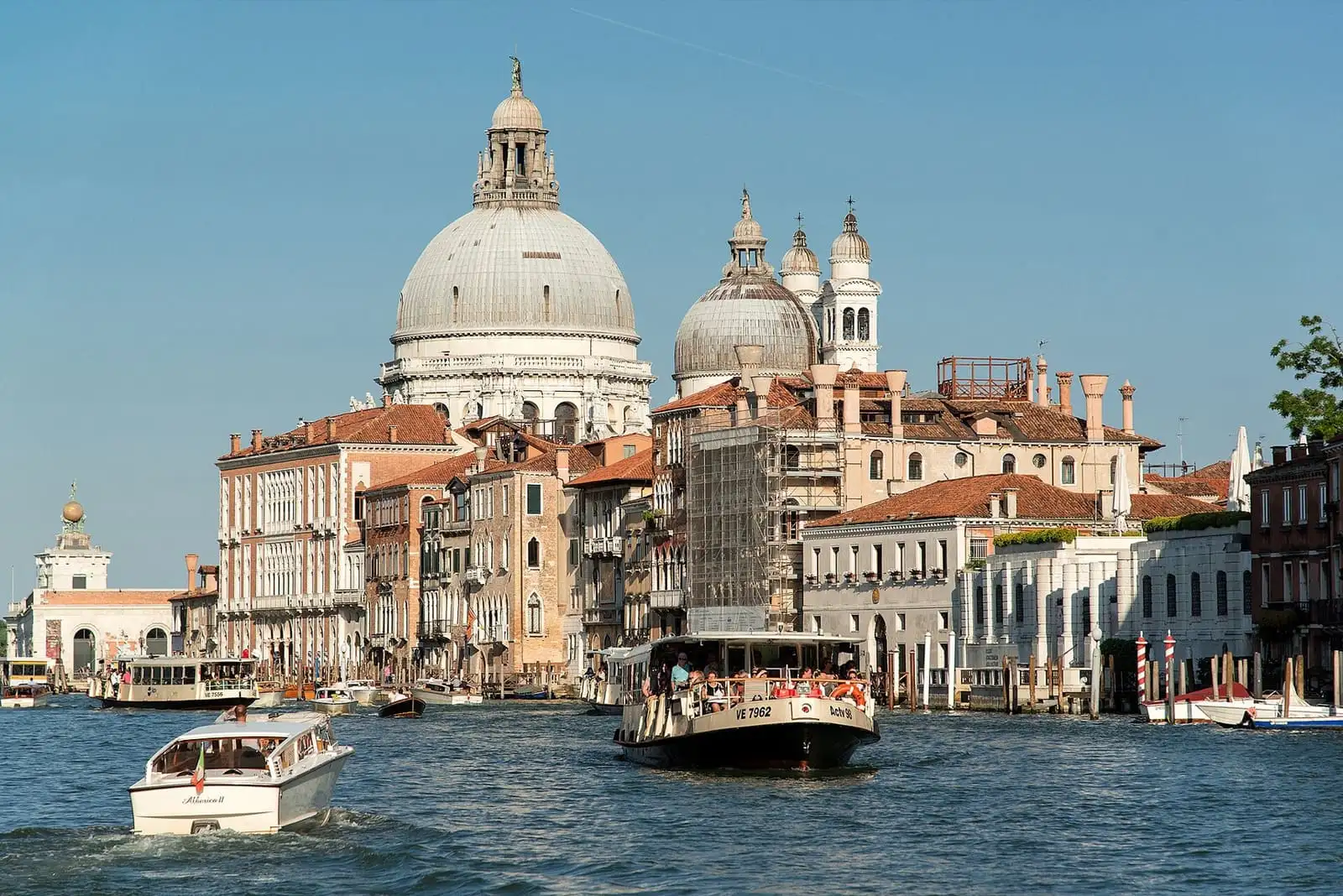

A vaporetto and a water taxi on the Grand Canal near the Salute church.
| Vaporetto | Water taxi | Traghetto (gondola ferry) | |
|---|---|---|---|
| What it is | Public water bus on fixed lines | Private motorboat for your group | Gondola that crosses the Grand Canal at a few fixed points |
| Price | €9.50 per person, or a pass | €80 per boat from the train station to a hotel in the city (online fare, November 2026) | €2 per person at San Tomà |
| Where it takes you | Stop to stop | The destination you book in the city | One bank to the other |
| Best for | Getting around all day | Heavy luggage, groups, late arrivals | A short, cheap gondola crossing |
| Book | See the pass | Consorzio Motoscafi Venezia | No booking |
The vaporetto is the default for almost every trip. A water taxi makes sense when you have big suitcases, when a group can split the fare, or when you arrive late and want to go straight to your hotel. The Consorzio Motoscafi Venezia sells fixed fares online; its booking page warns that some hard-to-reach destinations carry a €20 surcharge paid to the driver.
A traghetto is a working gondola rowed across the Grand Canal at a handful of points. At San Tomà it costs €2 for visitors and runs daily from 8:30am to 6pm in winter (to 7pm from April to October), weather permitting. It is the cheapest way to sit in a gondola for a few minutes, but it only crosses the canal. For a real ride and where to find the other crossings, read our gondola ride guide.
Getting to the vaporetto from the airport and the station
From Santa Lucia station, the Ferrovia stop is on the Grand Canal in front of the station, and lines 1, 2 and 3 all stop there. If you are coming from Milan, our Milan to Venice train guide covers the arrival at Santa Lucia and Mestre.
From Marco Polo Airport, ACTV bus 5 (Aerobus) runs to Piazzale Roma for €10, or €18 with a 90-minute ticket that includes the vaporetto. If you plan to buy a pass, add the airport supplement (€7 one way, €13 return) at the same time, because you cannot add it later. The Alilaguna boats from the airport are a separate company and need their own ticket. Every option is compared in our guide to Marco Polo Airport to Venice.
Day-trippers on certain dates also pay the city’s access fee, which is separate from any transport ticket: see our Venice access fee guide.
Frequently asked questions
How much does the vaporetto cost in Venice?
A single ticket costs €9.50 and is valid for 75 minutes from the first validation, with changes of boat allowed. Passes cost €25 for 24 hours, €35 for 48 hours, €45 for 72 hours and €65 for 7 days. Children under 6 travel free.
How do I pay for the vaporetto?
The simplest way is to tap a contactless Visa, Mastercard, Maestro, V Pay or American Express card, or your phone, on the validator at the stop. You can also buy tickets in the AVM Venezia app, on WhatsApp, online at veneziaunica.it, at the machines and ticket offices at the main stops, or on board by card if you ask the crew as you step on.
Is a vaporetto pass worth it?
The 24-hour pass at €25 pays off from the third ride, because three single tickets cost €28.50. The 48-hour pass needs four rides, the 72-hour pass five and the 7-day pass seven. If you tap a contactless card, ACTV caps the charge at the pass price for you.
Can you take luggage on a vaporetto in Venice?
Yes. Each passenger can bring up to three bags free, as long as each one measures no more than 150 cm (59 inches) in length plus width plus height. Extra bags need one more ticket for every one to three pieces, and anything bigger than 150 cm is not allowed on board.
What is the difference between a water taxi and a vaporetto?
The vaporetto is the public water bus run by ACTV, with fixed lines and stops and a fare of €9.50 per person. A water taxi is a private motorboat that takes your group to the destination you book; the online fare from the train station to a hotel in the city was €80 per boat for a date in November 2026.
Does the vaporetto pass include the airport?
No. ACTV passes do not cover trips to or from Marco Polo Airport, and they never cover the Alilaguna boats. You can add the airport bus to a 1, 2, 3 or 7-day pass for €7 one way or €13 return, but only when you buy the pass.
Which vaporetto goes along the Grand Canal?
Line 1 stops at almost every stop on the Grand Canal between Piazzale Roma and San Marco, then continues to the Lido. Line 2 makes fewer stops and is faster, but in the winter timetable it only runs past Rialto to Accademia and San Marco during the day.