
Quick answer
The Grand Canal is the main waterway of Venice, 3.8 km (2.4 miles) long, curving in a reverse S from the train station to St. Mark’s Basin. The cheapest way to see it is vaporetto line 1: €9.50 for 75 minutes and 44 minutes from Piazzale Roma to San Marco, past almost every palace. For commentary, a one-hour guided boat tour costs €45, and a gondola costs €90 for 30 minutes by day.
Prices and times checked on 14 November 2026, on the ACTV winter timetable in force from 2 November 2026.
There is no ticket and no opening time for the Grand Canal itself: it is the city’s main street, and you see it from the water or from the few places where the land reaches it. This guide covers the boats, from the €9.50 vaporetto to a shared gondola, then the palaces in the order you pass them, the bridges, and the best spots on foot and at sunset.
Grand Canal facts: how long, how wide, how deep
| Grand Canal | |
|---|---|
| Length | About 3.8 km (2.4 miles) |
| Width | 30 to 70 m (about 100 to 230 ft) |
| Depth | Up to 5 m (16 ft) |
| Shape | A reverse S from northwest to southeast |
| From | Piazzale Roma and Santa Lucia station |
| To | St. Mark’s Basin, by the Salute church |
| Bridges | 4 |
| Side canals branching off it | 45 |
The canal splits the historic center into two unequal parts. On one side are Cannaregio and San Marco, on the other Santa Croce, San Polo and Dorsoduro.
How many canals does Venice have? Besides the Grand Canal, the historic center has a network of 158 smaller canals, called rii. Venice is built on about 120 islands, and the canals are the water between them, which is why the city has canals instead of streets for its deliveries, buses and taxis.
Is the Grand Canal a river? No. It probably follows the bed of an ancient river, but today it is a channel of the lagoon, filled with salty water that comes in from the Adriatic. The lagoon has two high tides and two low tides a day, so the water level on the canal changes from hour to hour; when it rises far enough to flood the lowest streets, that is acqua alta. No river runs through Venice.
How deep are the canals in Venice? The Grand Canal reaches 5 meters at most. The smaller canals are much shallower: when the city dredges them, it digs to 1.8 meters (about 6 feet) at the center, measured from the city’s tide datum, so the real depth goes up and down with the tide. Swimming in any canal is banned and carries a €350 fine.
How to see the Grand Canal: every option
| Option | Price | Time on the canal | Good for | Book |
|---|---|---|---|---|
| Vaporetto line 1 | €9.50 for 75 minutes | 44 minutes, Piazzale Roma to San Marco | The whole canal, cheaply | See the pass |
| Vaporetto line 2 | €9.50 for 75 minutes | 33 minutes, daytime only | Getting somewhere fast | See the pass |
| Guided boat tour, shared | €45 per person | 1 hour | Commentary on the palaces | See the tour |
| Guided boat tour, small group | From €99 per person | 1.5 hours | A guide and a small boat, max 8 | See the tour |
| Gondola, private | €90 for 30 minutes by day, per boat | Part of the ride | Up to 5 people | See gondola rides |
| Gondola, shared seat | From €37 per person | About 30 minutes | Solo travelers and couples | See the ride |
| Traghetto | €2 per person | A few minutes, across only | A cheap moment in a gondola | Pay on board |
| Water taxi | Priced per boat | Your route | Groups with luggage | See our water taxi guide |
| On foot | Free | As long as you like | Bridges, markets, sunset | No booking |
For most first-time visitors the answer is line 1 once, end to end, plus the Rialto and Accademia bridges on foot. Add a guided boat or a gondola if you want someone to tell you whose palace you are looking at.
Vaporetto line 1: the Grand Canal for €9.50
Line 1 is the regular ACTV water bus, and it stops almost everywhere on the canal: 16 stops from Piazzale Roma to San Marco Vallaresso, then on along the waterfront to the Lido.
| From Ferrovia (train station) to | Time on line 1 |
|---|---|
| Ca’ d’Oro | 11 minutes |
| Rialto | 19 minutes |
| Accademia | 32 minutes |
| Salute | 37 minutes |
| San Marco Vallaresso | 41 minutes |
From Piazzale Roma add 3 minutes, 44 minutes in all. Boats leave every 12 minutes from 6:21am to 7:57pm, then every 12 to 20 minutes until the last departure at 11:41pm; after that the night line N follows the canal.
How to get the most out of it:
- Board at Piazzale Roma or Ferrovia, the first two stops, when the boat is emptiest, and ride toward San Marco.
- Stand in the open area by the boarding gate. It is the best place for photos; the cabin seats look out through windows.
- Validate before you walk onto the pontoon: tap a contactless card or your phone, or use a ticket. A single ride is €9.50 for 75 minutes, and the €25 daily pass pays off from the third ride. Our vaporetto guide explains tickets, passes and luggage rules.
Line 2 makes fewer stops (among them Ferrovia, Rialto, San Tomà, San Samuele and Accademia) and takes 33 minutes from Piazzale Roma to San Marco. In the winter timetable it only runs past the Rialto during the day, with the first arrival at San Marco at 9:51am and the last at 5:03pm; the other runs end at the Rialto. Use it to get somewhere, and line 1 to look.
Grand Canal map: the palaces stop by stop
Riding line 1 from the station toward San Marco, the Cannaregio and San Marco bank is on your left, and the Santa Croce, San Polo and Dorsoduro bank on your right. The table follows the canal in that order, with the stop for each building. For the full network, ACTV publishes an official map of every line and stop, and our map of Venice shows the six districts the canal runs through. Opening days and prices for the museums are compared in our Venice museums guide.
| Stop | On your left | On your right |
|---|---|---|
| Piazzale Roma | The boat passes under the Ponte della Costituzione | Piazzale Roma, the bus terminal |
| Ferrovia | Santa Lucia station, then the Ponte degli Scalzi overhead | San Simeone Piccolo, the church with the green dome |
| Riva de Biasio | San Marcuola church | Fondaco dei Turchi (Natural History Museum) |
| San Marcuola | Ca’ Vendramin Calergi (Casino) | |
| San Stae | San Stae church, Ca’ Pesaro | |
| Ca’ d’Oro | Ca’ d’Oro | |
| Rialto Mercato | Rialto Market and the fish market loggia | |
| Rialto | Fondaco dei Tedeschi, Rialto Bridge | Palazzo dei Camerlenghi |
| San Silvestro | Ca’ Farsetti and Ca’ Loredan (City Hall) | Riva del Vin |
| San Tomà | Ca’ Foscari, on the canal’s widest bend | |
| Ca’ Rezzonico | Palazzo Grassi | Ca’ Rezzonico |
| Accademia | Palazzo Cavalli-Franchetti, Accademia bridge | Gallerie dell’Accademia |
| Accademia to Salute | Palazzo Corner della Ca’ Granda | Peggy Guggenheim Collection |
| Salute | Santa Maria della Salute, Punta della Dogana | |
| San Marco Vallaresso | St. Mark’s Square, a short walk inland |
From the station to the Rialto
The canal opens at Ponte della CostituzioneMap, the newest of its bridges, between Piazzale Roma and the station. A little further on, past the station and the Ponte degli ScalziMap, the long arcaded front on your right is the Fondaco dei TurchiMap. It was built in the 13th century as a palace for the Pesaro family, served from 1621 to 1838 as the warehouse and lodging of the Turkish merchants, and has housed the Natural History Museum since 1923 (closed Mondays; stop Riva de Biasio).
On the left bank, a little further on, Ca' Vendramin CalergiMap is a Renaissance palace that now holds the city’s casino; Richard Wagner lived here, and the casino arranges visits to his rooms through the local Wagner association.
Then comes Ca' PesaroMap, a baroque palace that Baldassare Longhena began in 1659 for the Pesaro family and that was finished only in 1710. It is now the International Gallery of Modern Art and the Museum of Oriental Art, on one ticket (€15, closed Mondays, stop San Stae).
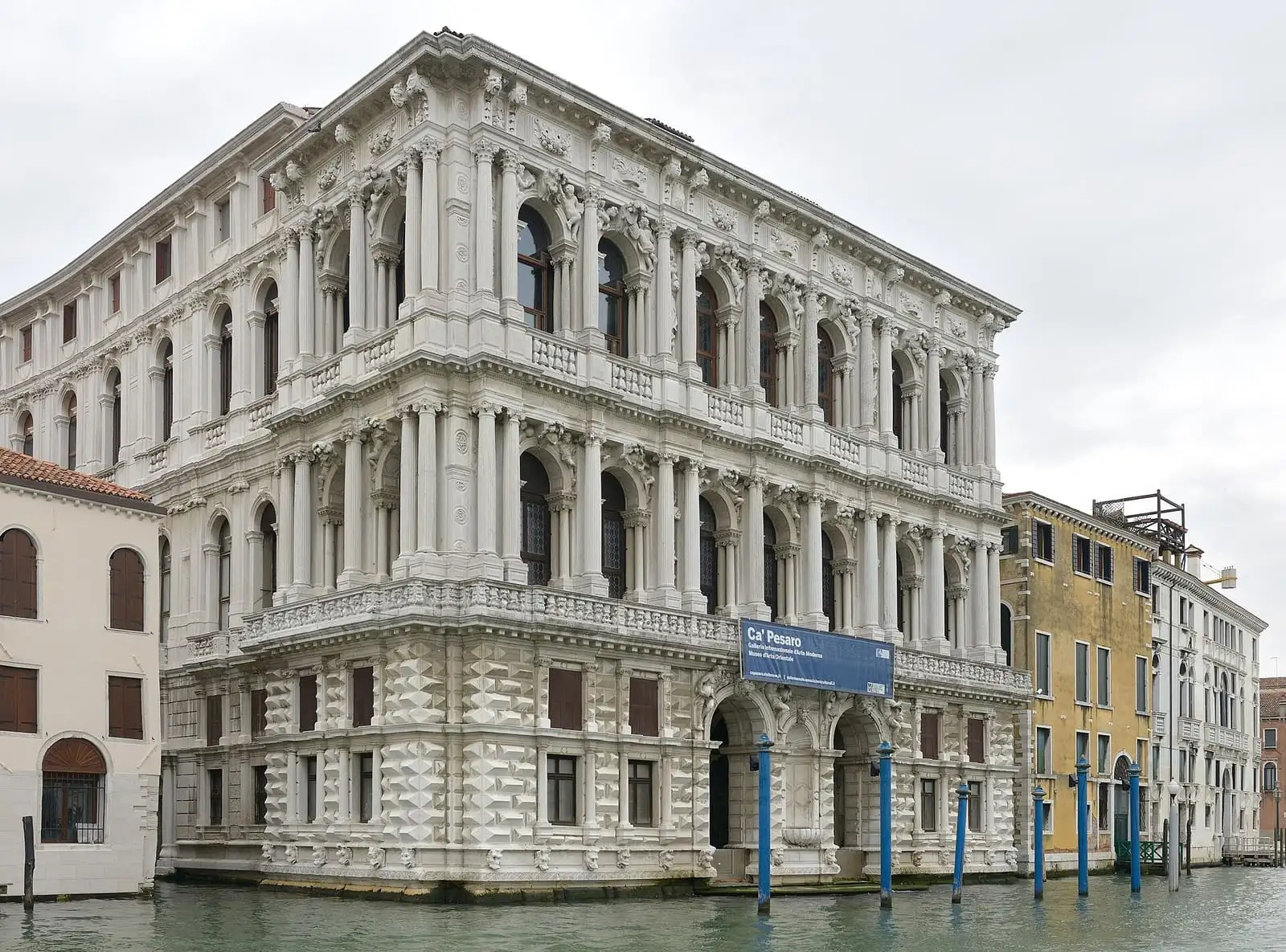

Ca' Pesaro, Longhena's baroque palace on the Grand Canal, now the International Gallery of Modern Art.
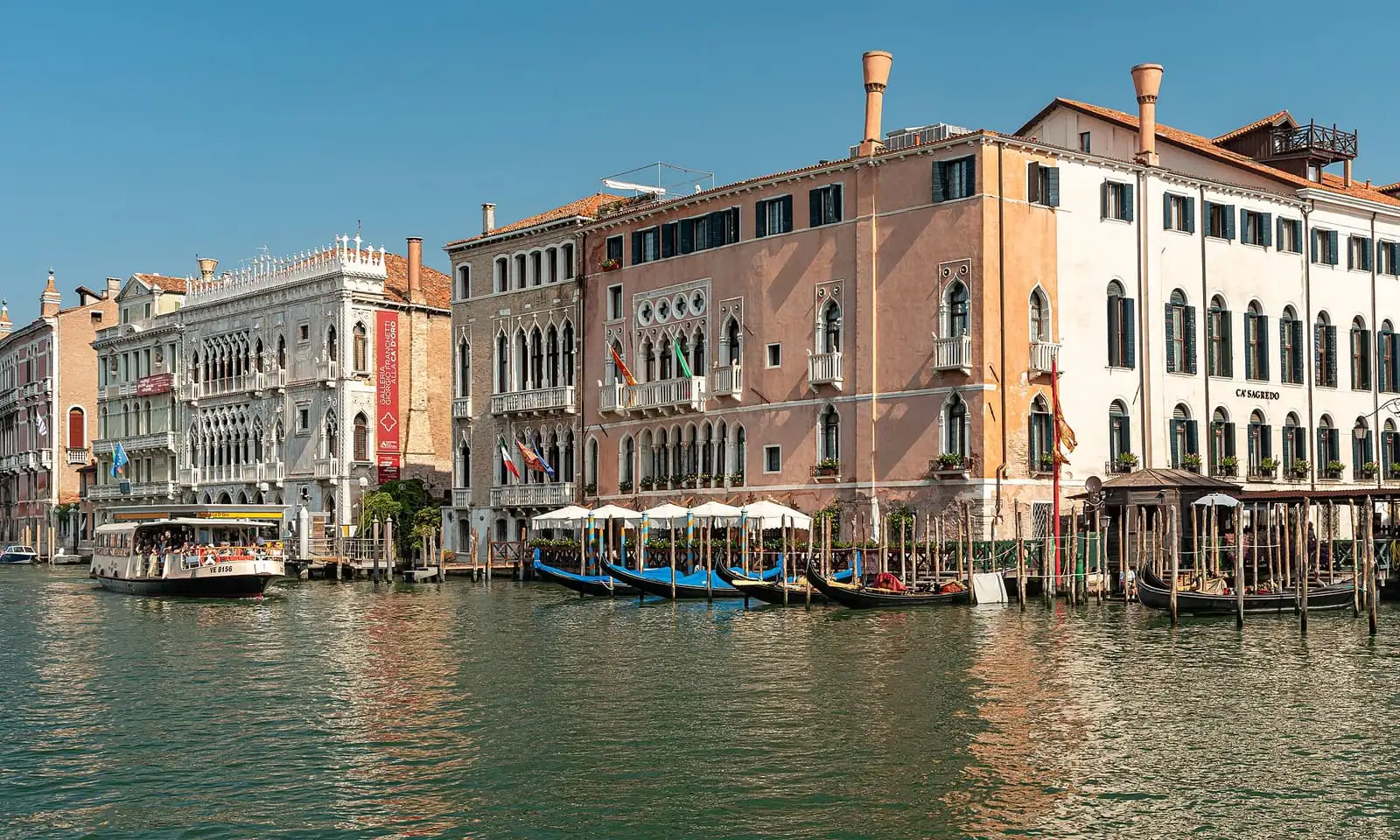
On the opposite bank stands Ca' d'OroMap, one of the finest late-Gothic palaces in Venice, with open stone loggias on two floors. Inside is the Galleria Giorgio Franchetti, the collection that Baron Giorgio Franchetti gave to the Italian State in 1916 together with the building. The museum has been closed since 2 February 2026 for restoration and a new layout, and is expected to reopen in spring 2027, so for now you see it from the water.
The Rialto
Past the market stop, the stone Rialto BridgeMap crosses the canal. Built between 1588 and 1591, it was the only way across on foot until 1854. On the right bank are the Rialto MarketMap (fish Tuesday to Saturday mornings, fruit and vegetables Monday to Saturday) and the Palazzo dei Camerlenghi at the foot of the bridge. On the left, the big square building is the Fondaco dei TedeschiMap, once the German merchants’ warehouse; its rooftop terrace now opens only on occasional dates. Our Rialto Bridge guide has the market hours and the best viewpoints.
The great bend: Ca’ Foscari, Ca’ Rezzonico, Palazzo Grassi
After San Tomà the canal turns sharply. On the outside of the bend, the volta de Canal, stands Ca' FoscariMap, built in 1453 for Doge Francesco Foscari. Since 1868 it has housed the school that grew into Ca’ Foscari University, and it is still the university’s main building.
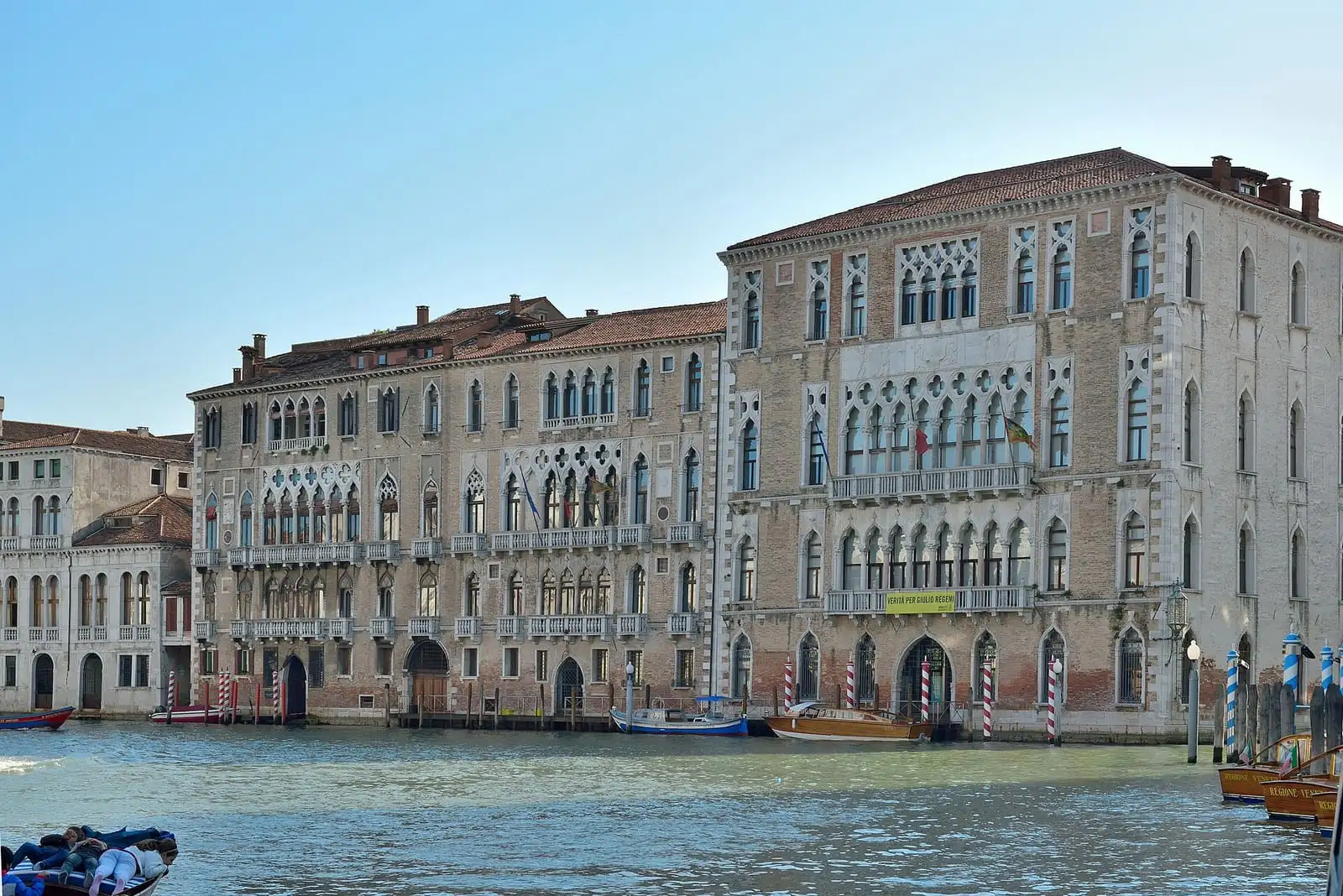

Ca' Foscari on the volta de Canal, the widest bend of the Grand Canal, with Palazzo Giustinian beside it.
At the next stop, Ca' RezzonicoMap holds the Museum of 18th-century Venice (€15, closed Tuesdays, stop Ca’ Rezzonico). Longhena started it, the money ran out, and the Rezzonico family had Giorgio Massari finish it in the 1750s. The poet Robert Browning died here in 1889, and Cole Porter rented it in 1926 and 1927.
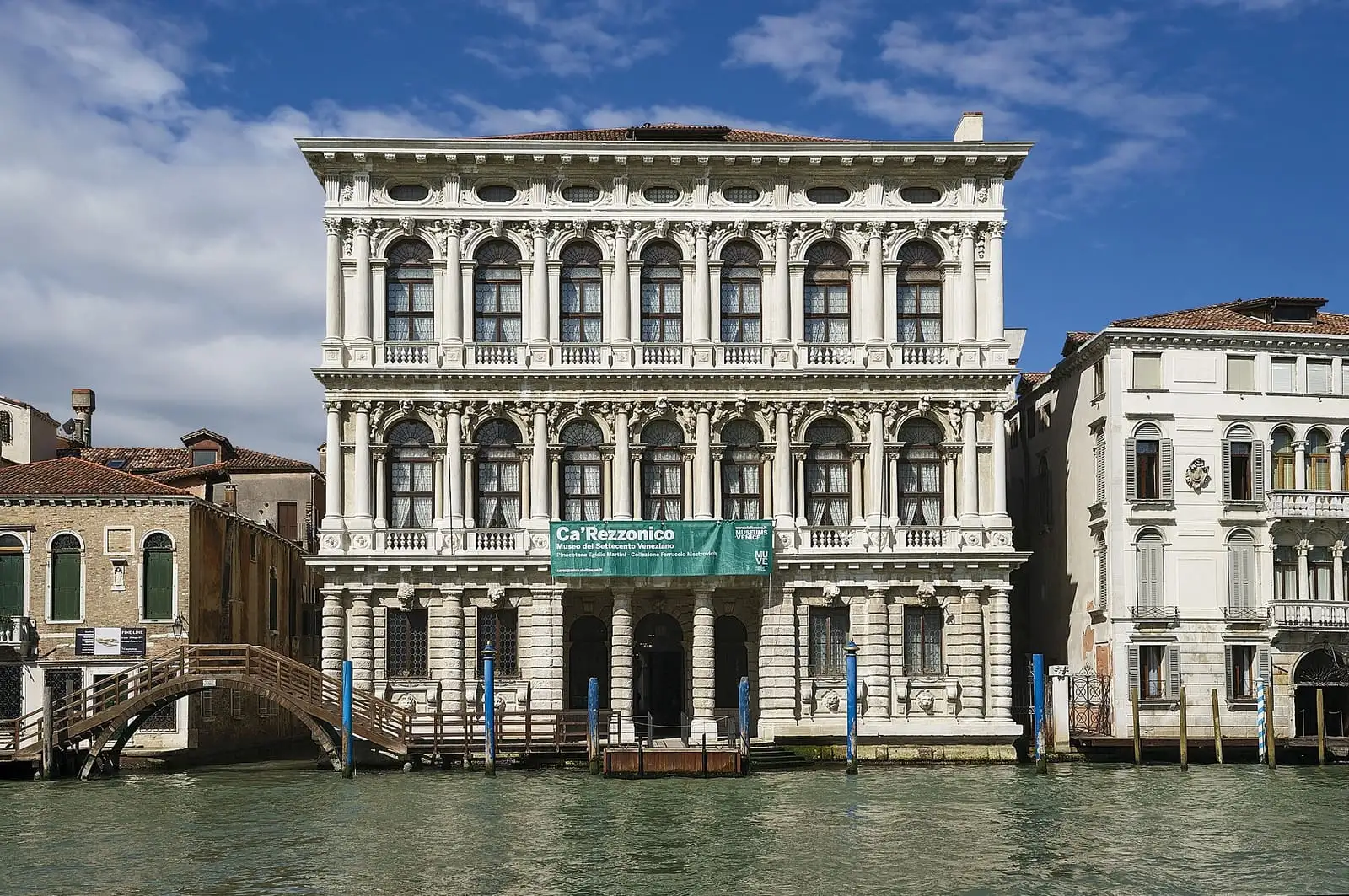

Ca' Rezzonico, home of the Museum of 18th-century Venice, seen from the Grand Canal.
Across the water is Palazzo GrassiMap, built by Massari between 1748 and 1772: the last noble residence on the Grand Canal before the fall of the Venetian Republic. Today it shows exhibitions of the Pinault Collection (open during exhibitions, closed Tuesdays; stops San Samuele on line 2 or Sant’Angelo on line 1).
The Accademia to the Salute: the entrance of the canal
The wooden arch of the Ponte dell'AccademiaMap leads to the Gallerie dell'AccademiaMap, the great collection of Venetian painting (€15, closed Mondays). Past it, on the same bank, Palazzo Venier dei Leoni holds the Peggy Guggenheim CollectionMap of 20th-century art (€17, closed Tuesdays). See our Peggy Guggenheim guide.
The canal ends, or for anyone arriving from the lagoon begins, at Basilica di Santa Maria della SaluteMap, the domed church that is free to enter, and at Punta della DoganaMap, the old customs point where the Grand Canal meets St. Mark’s Basin. From the San Marco Vallaresso stop opposite, St. Mark's SquareMap is a short walk away.
The four bridges over the Grand Canal
Until 1854 the Rialto was the only bridge. Today there are four, and between them a traghetto ferries you across in a few minutes.
| Bridge | Built | Connects | Stop |
|---|---|---|---|
| Ponte della Costituzione | 2008, designed by Santiago Calatrava | Piazzale Roma and the station | Piazzale Roma |
| Ponte degli Scalzi | 1934 | The station and Santa Croce | Ferrovia |
| Rialto Bridge | 1588 to 1591, in stone | San Marco and San Polo | Rialto |
| Ponte dell’Accademia | A wooden arch | San Marco and Dorsoduro | Accademia |
All four have steps, so with a stroller or a heavy suitcase take the vaporetto under them instead.
Grand Canal boat tours
A guided boat covers what a vaporetto cannot: who built each palace and what happened in it. Two guided boat tours cover the canal, both with free cancellation up to 24 hours before.
| Tour | Length | Group | Price | Starts | Book |
|---|---|---|---|---|---|
| Grand Canal Boat Tour | 1 hour | Shared motorboat, live guide in English | €45 | Riva degli Schiavoni | See the tour |
| Grand Canal by Boat with Expert Guide | 1.5 hours | Max 8, or private, with headsets | From €99 | Museo Correr, St. Mark’s Square | See the tour |
The one-hour tour is the cheaper choice, with a live guide on a shared motorboat from the Riva degli Schiavoni. It is marked as likely to sell out, so book ahead in high season. The 1.5-hour tour starts with a short talk in St. Mark’s Square, then boards a small boat with headsets; it has a dress code (no shorts, short skirts or sleeveless tops) and does not take strollers. Neither tour suits a wheelchair user.
Book a Grand Canal boat tourMore options, including gondola rides and private boats, are on the Grand Canal tours page.
Gondolas and the €2 traghetto on the Grand Canal
The City of Venice sets the gondola fare: €90 for 30 minutes between 9am and 7pm and €110 for 35 minutes from 7pm to 4am, per boat, for up to 5 people. Routes depend on the gondola station, and many spend more time in the side canals than on the Grand Canal, so if the Grand Canal is the point, say so to the gondolier and agree the route before you step aboard. A shared Grand Canal gondola ride sells single seats, from €37 per person.
The traghetto is a working gondola that only crosses the canal, for €2 a person. Five crossings run, all during the day:
- Santa Sofia, from Campo Santa Sofia to the fish market: 8:30am to 7pm on weekdays.
- San Tomà, between San Polo and the San Marco bank: 8:30am to 7pm on weekdays.
- Santa Maria del Giglio and Dogana, near the mouth of the canal: 9am to 6pm.
- Carbon, by the Rialto: 9am to noon on weekdays only.
Weekend hours are shorter, and there is no service on 1 January, 15 August, 25 and 26 December. Our gondola ride guide lists the gondola stations, routes and how to avoid problems.
Can you walk along the Grand Canal?
Not from end to end. Most palaces rise straight out of the water, so there is no promenade along either bank. You walk the parallel streets and come out on the canal at bridges, squares and short waterfronts. Santa Lucia station to St. Mark’s Square is 30 to 34 minutes on foot.
The best places to see the Grand Canal from land:
- The Rialto Bridge. The most famous view, down the canal toward the Riva del Vin. Go before 9am or after dark for room at the balustrade.
- The Accademia bridge. Looking one way you see the Salute; looking the other, the canal toward Palazzo Grassi and the bend.
- Riva del Vin and the Erbaria, on the San Polo side of the Rialto: one of the few stretches where you can walk along the water, facing Ca’ Farsetti and Ca’ Loredan, the City Hall.
- Strada Nuova, the long street that runs parallel to the canal from the station to Campo Santi Apostoli, with lanes off it that end at the water, such as the one to the Ca’ d’Oro stop.
- The Salute steps and Punta della Dogana, at the mouth of the canal, looking across to San Marco and back up the Grand Canal.
- The Ponte degli Scalzi, by the station, for the first view of the canal and San Simeone Piccolo.
Sunset on the Grand Canal
The sun sets around 4:30pm at the end of November and around 9pm in late June. From the Rialto Bridge, the view toward the Riva del Vin faces southwest, and from the Accademia bridge the view away from the Salute faces west, toward Palazzo Grassi: both look into the evening light. For a sunset on the water, a gondola is charged at the day fare (€90) whenever the sun goes down before 7pm, which is the case from late September to late March.
Events on the Grand Canal
The Regata Storica, the city’s historic regatta, is rowed on the Grand Canal every year on the first Sunday of September (the 2026 edition was on 6 September). On the opening weekend of the Carnival, the Festa Veneziana water parade rows about a hundred boats up the canal from Punta della Dogana to the Rialto; in 2026 vaporetto lines 1 and 2 went around by the Giudecca canal that morning. Our Venice Carnival guide has the 2027 dates.
Staying on the Grand Canal
A room facing the canal costs more, and in most hotels only some rooms have it. Our guide to hotels on the Grand Canal lists ten that really face the water, with the room to book and its price, or browse hotels on the Grand Canal on Booking.com. For the rest of the city, start with our things to do in Venice.
Frequently asked questions
How much does it cost to see the Grand Canal in Venice?
Nothing, if you look at it from the bridges and the waterfronts. The cheapest ride along it is vaporetto line 1 at €9.50 for a 75-minute ticket. A gondola costs €90 for 30 minutes by day for up to 5 people, and the traghetto, a gondola that only crosses the canal, costs €2.
Can you walk along the Grand Canal in Venice?
Not from end to end. Most palaces stand straight on the water, so you walk inland and come out on the canal at bridges, squares and short waterfronts. Four bridges cross it, and the walk from the train station to St. Mark's Square takes 30 to 34 minutes.
How much is a gondola ride on the Grand Canal?
The city fare is €90 for 30 minutes between 9am and 7pm and €110 for 35 minutes from 7pm, per boat, for up to 5 people. A seat on a shared Grand Canal gondola ride booked online started at €37 per person on 14 November 2026.
How long and how deep is the Grand Canal?
It is about 3.8 km (2.4 miles) long, 30 to 70 meters wide and up to 5 meters (16 feet) deep. The smaller canals are much shallower, dredged to about 1.8 meters (6 feet) at the center, and the water level changes with the tide.
Is the Grand Canal a river?
No. It is a channel of the Venetian lagoon, probably along the bed of an ancient river, and it carries salty lagoon water that rises and falls with two high tides and two low tides a day. No river flows through Venice.
Which vaporetto goes along the Grand Canal?
Line 1 stops almost everywhere on the canal and takes 44 minutes from Piazzale Roma to San Marco Vallaresso, with a boat every 12 minutes during the day. Line 2 is faster, but in the winter timetable it only continues past the Rialto during the day.
Why is the Grand Canal famous?
It is the main street of Venice and the place where its richest families built their palaces for five centuries, from the 13th-century Fondaco dei Turchi to Palazzo Grassi, finished in 1772. The Rialto Bridge and the Salute church stand on it.