
Quick answer
The Peggy Guggenheim Collection is open 10am to 6pm every day except Tuesday and 25 December, with last entry at 5pm. A full ticket costs €17 at the desk or €18 online, €14 over 70, €9 for students under 26 and ages 10 to 18, and nothing under 10. A fast track ticket lets you walk in at any time in a two-hour window instead of a fixed slot. Plan on 1.5 to 2 hours; Peggy Guggenheim’s ashes are in the garden, next to her dogs.
Prices and times checked on 13 November 2026.
What the Peggy Guggenheim Collection is
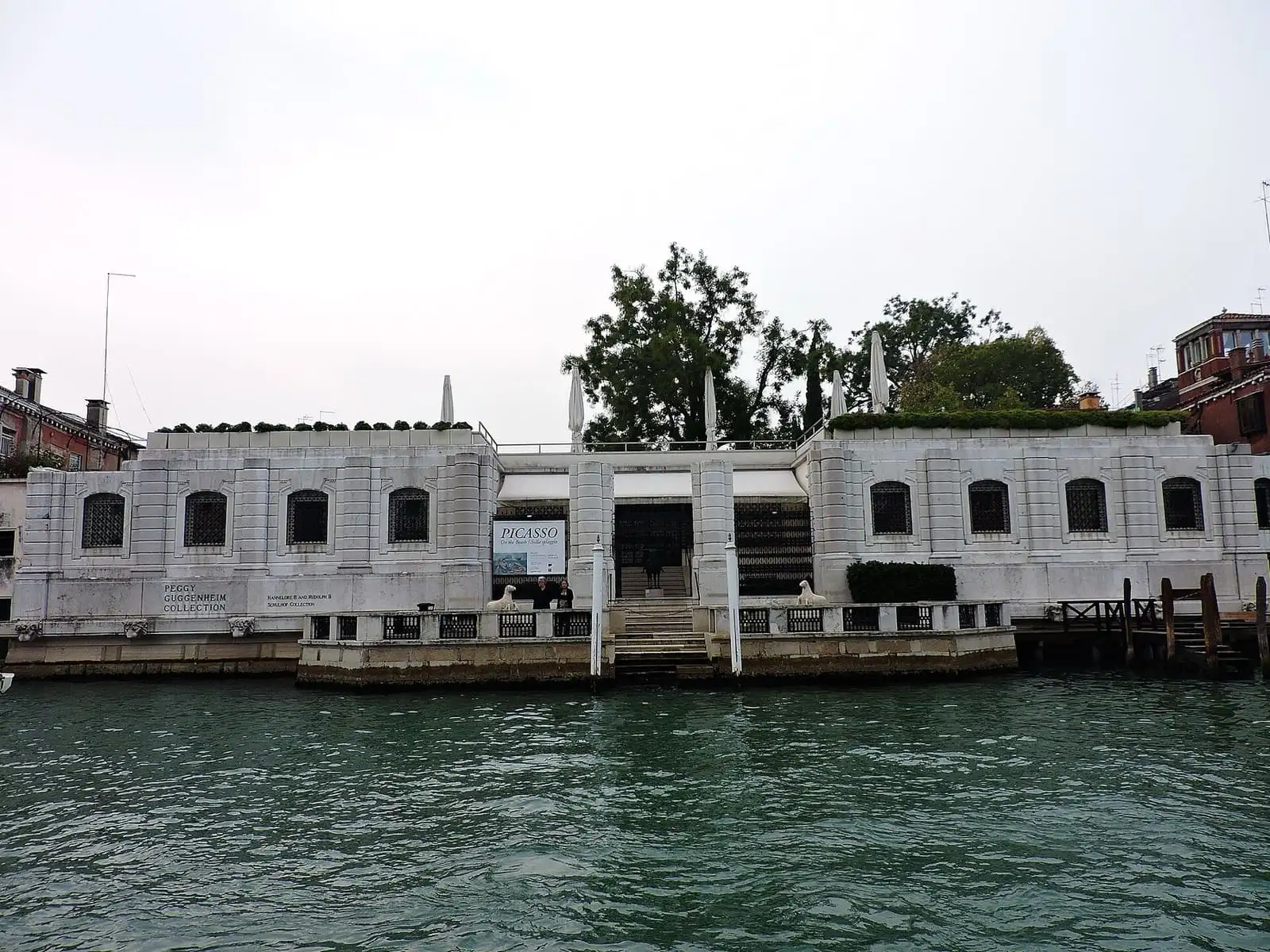
The Peggy Guggenheim CollectionMap is the house where the American collector Peggy Guggenheim lived from 1949 to 1979, on the Grand Canal between the Accademia bridge and the Salute churchMap. Today it shows her collection of European and American art of the 20th century, a second private collection (the Hannelore B. and Rudolph B. Schulhof Collection), a sculpture garden and temporary exhibitions. It belongs to the Solomon R. Guggenheim Foundation, the same foundation that runs the Guggenheim in New York.
The building is Palazzo Venier dei Leoni, a palace begun in 1749 and never finished: only the ground floor of the five planned stories was built. That is why it looks so low next to its neighbors on the canal. Peggy opened her home to the public for free a few afternoons a week from 1951, and the museum opened in its current form in 1980.
Tickets and prices
| Ticket | At the desk | Online | Who qualifies | Book |
|---|---|---|---|---|
| Full price | €17 | €18 | Adults | Museum shop or fast track |
| Reduced | €14 | €15 | Visitors over 70, holders of a ticket from another Dorsoduro Museum Mile venue | Museum shop |
| Student | €9 | €10 | Students under 26 with ID, ages 10 to 18, Rolling Venice card holders | Museum shop |
| Free | €0 | €0 | Children under 10, visitors with disabilities and a care partner, Guggenheim members | Museum shop |
| Audio guide | €7 | Sold as a ticket option | Italian, English, French, German, Spanish | Museum shop |
The online price includes a €1 presale fee. The ticket covers the permanent collection and the temporary exhibition on view, with no separate exhibition ticket.
Two discounts that matter to Americans:
- Guggenheim members get in free. The museum admits members of all Guggenheim museums, so a current membership card from the New York Guggenheim saves you the ticket.
- The Dorsoduro Museum Mile. A ticket from one of the partner museums nearby gets you the €14 rate here within 7 days, and a Guggenheim ticket gets you discounts there (see the nearby section below).
If you bought a reduced ticket online, bring ID that proves you qualify: the desk checks it.
How to book
Buy from the museum’s official shop, ticket.guggenheim-venice.it, which the museum’s own visit page links to.
- Choose Entrance Ticket, or Entrance Ticket with Audio Guide if you want the audio guide included.
- Pick a date and an entry time. Slots run every 30 minutes from 10am to 4:30pm.
- Pick the ticket type for each person and pay.
The catches: online tickets cannot be refunded, and the museum asks you to stick to your date and time, so late arrivals may be turned away. You can also buy at the ticket office in person, where there is no booking fee and the other discounts on the museum’s list are available.
If you want more flexibility or a guide, two resellers are worth knowing. The Tiqets fast track ticket lets you walk in at any time in a two-hour window instead of a fixed slot. A private guided tour on GetYourGuide adds a guide for the museum and a walk around Dorsoduro.
The museum also runs its own guided tour in English of the permanent collection on Saturdays and Sundays at 3pm. It lasts an hour, costs €10 per person on top of the entrance ticket (free under 6), takes up to 15 people and is booked on the same shop.
Opening hours and free talks
| Time | |
|---|---|
| Open | 10am to 6pm |
| Ticket office and last entry | 5pm |
| Rooms start closing | 5:50pm |
| Closed | Every Tuesday and 25 December |
| Free talks (with your ticket) | 11:30am and 3:30pm Peggy Talk, 12pm and 4pm Art Talk |
The free talks last 10 to 15 minutes, need no booking and are given in English or Italian, depending on the guide. The Peggy Talk covers her life between New York, Paris, London and Venice; the Art Talk picks one work from the collection each day.
Plan your week around the closing days. The Guggenheim closes on Tuesdays and the Gallerie dell'AccademiaMap on Mondays, so on a Monday or Tuesday only one of the two big Dorsoduro museums is open. The rooms are domestic in scale and fill up quickly, so a 10am slot is the safe choice in busy months.
Book Peggy Guggenheim ticketsWhat to see inside
Peggy’s collection
Peggy Guggenheim started collecting in 1938 and bought many of her best-known works in Paris in 1939-40. The house is hung with Cubist, Surrealist and abstract art. Among the works listed as on view on 13 November 2026:
- René Magritte, Empire of Light (1953-54), a dark night street under a bright daytime sky.
- Pablo Picasso, On the Beach (1937) and The Studio (1928).
- Vasily Kandinsky, Upward (1929), and Paul Klee, Portrait of Frau P. in the South (1924).
- Giorgio de Chirico, The Red Tower (1913), and Max Ernst, Attirement of the Bride (1940).
- Jackson Pollock, Alchemy (1947), one of his earliest poured paintings, plus Circumcision and Croaking Movement (both 1946).
- Constantin Brancusi, Maiastra (about 1912) and Bird in Space (1932-40), which Peggy bought as the German army approached Paris.
- Alexander Calder, Silver Bedhead (1943) and the Earrings for Peggy Guggenheim (about 1938).
Not everything is always on the walls. On the same day, Pollock’s The Moon Woman and Enchanted Forest and Salvador Dalí’s Birth of Liquid Desires were listed as not on view. If you are coming for one painting, look it up on the museum’s online collection, which marks every work as On view or Not on view.
The garden and the canal terrace
The Nasher Sculpture Garden behind the house has sculptures by artists such as Jean Arp, Alberto Giacometti and Arnaldo Pomodoro, some of them outdoors since the 1940s. The low pavilion along the garden holds the Schulhof Collection, and the museum’s bistrot is open 10am to 5:45pm for ticket holders only.
On the Grand Canal side, a terrace runs in front of the house. Marino Marini’s bronze horse and rider, The Angel of the City (1948), stands on the terrace facing the water, and the view takes in the palaces on the San Marco bank opposite. Visitors arrive from the land side: there is no entrance from the canal.
The glass exhibition until March 2027
From 14 November 2026 to 29 March 2027 the temporary exhibition is Fucina degli Angeli: Peggy Guggenheim and 20th-Century Artistic Glass. It shows more than a hundred works from the Fucina degli Angeli, a Venetian gallery founded in 1955 by Egidio Costantini, which turned designs by artists such as Jean Cocteau, Max Ernst, Jean Arp and Oskar Kokoschka into glass in the furnaces of Murano. Peggy bought pieces for her collection and helped Costantini find buyers abroad.
It is a good complement to a trip to the furnaces: our Murano glass guide explains how the glass is made and how to tell the real thing.
Is Peggy Guggenheim buried in Venice?
Yes. Peggy Guggenheim died on 23 December 1979, aged 81, and her ashes are in a corner of the garden of her museum. The stone on the garden wall reads Here rests Peggy Guggenheim 1898-1979.
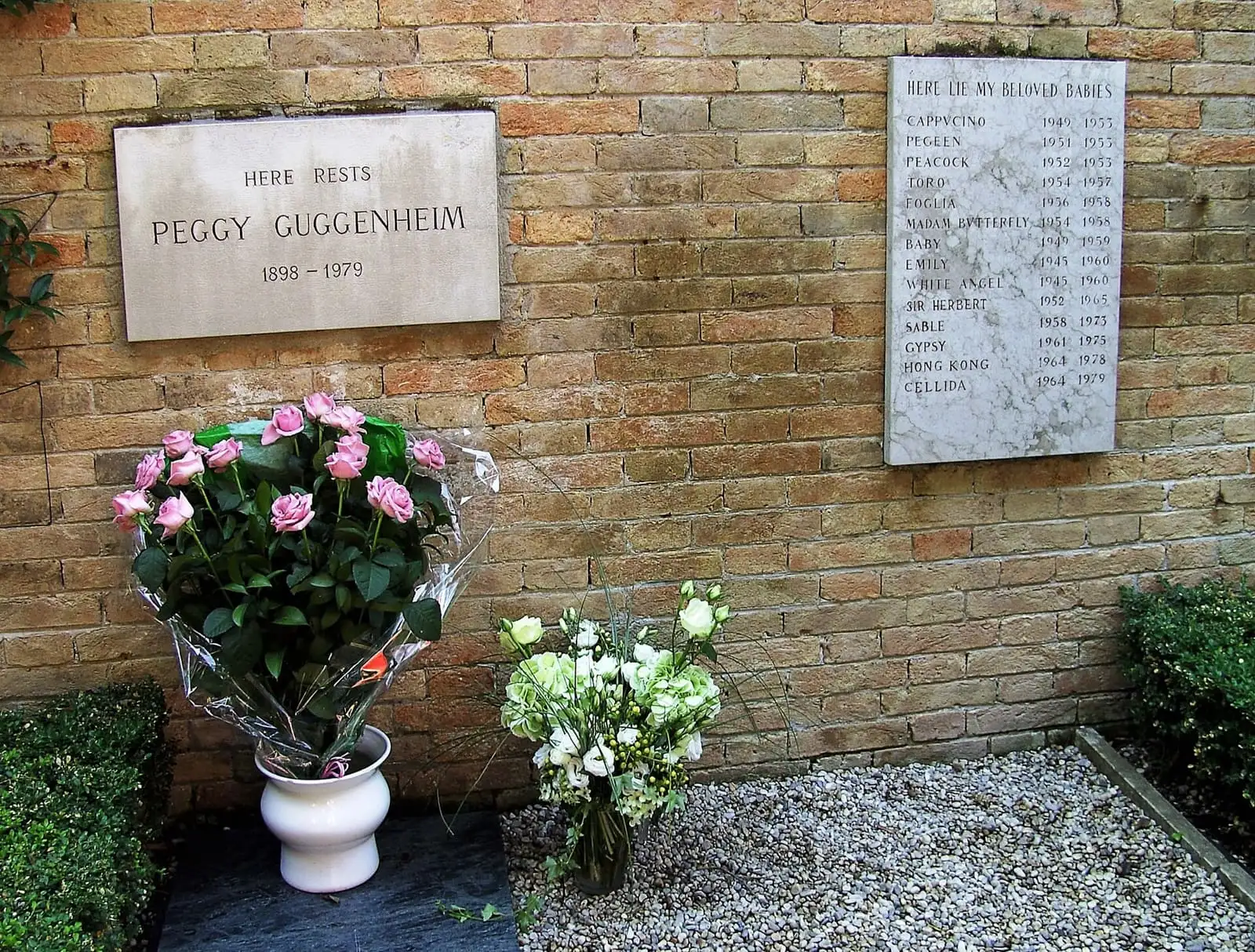

Peggy Guggenheim's stone and the plaque for her dogs on the garden wall of Palazzo Venier dei Leoni.
The plaque next to hers is for her dogs. Under the words Here lie my beloved babies it lists 14 dogs, each with two years, from Cappucino (1949-1953) to Cellida (1964-1979).
Why Peggy Guggenheim is famous
She was born in New York in 1898; her father, Benjamin Guggenheim, died on the Titanic in 1912. In 1938 she opened a gallery in London, and in Paris in 1939-40 she set herself the rule of buying “a picture a day”. In 1942 she opened Art of This Century on West 57th Street in New York, where she showed the young Americans who would become the Abstract Expressionists and gave Jackson Pollock the first of his four solo exhibitions there.
In 1948 she showed her collection at the Venice Biennale, the first time Pollock, Rothko and Arshile Gorky were seen in Europe, and the next year she bought the palace on the Grand Canal. Venice made her an honorary citizen in 1962. The Guggenheim Foundation has also owned the US Pavilion at the Biennale since 1986; our Biennale guide has the dates of the next edition.
How long you need
Plan on 1.5 to 2 hours for the house, the Schulhof rooms, the garden and the terrace. Add 30 to 45 minutes for the glass exhibition, and time your visit around a free talk if you want one: the 11:30am Peggy Talk works well with a 10:30am entry.
Large bags, backpacks and suitcases are not allowed inside; the lockers at the ticket office are free. You can take photos without flash for personal use, but not with a tripod or a selfie stick. Food and drink are not allowed anywhere in the museum, the garden included, and strollers are fine.
How to get there
The entrance is on the land side, at Dorsoduro 701, a short walk from two water bus stops.
| From | Line and stop | Walk to the entrance |
|---|---|---|
| Train station or Piazzale Roma | Line 1 or 2 toward Lido, get off at Accademia | 3 minutes, 210 m |
| Train station or Piazzale Roma | Line 1 toward Lido, get off at Salute | 4 minutes, 250 m |
| St. Mark’s Square | Line 1 (Salute or Accademia) or line 2 (Accademia) toward Piazzale Roma | 3-4 minutes |
| St. Mark’s Square on foot | Over the Accademia bridge | 12 minutes, 800 m |
A single water bus ticket costs €9.50 and lasts 75 minutes; our vaporetto guide explains passes and which line to take.
The museum is accessible: platform lifts take wheelchairs up the steps to the garden, the house, the bistrot and most of the temporary exhibition rooms. If you come as a day tripper on a day when the Venice access fee applies, that fee is separate from your museum ticket.
What to see nearby in Dorsoduro
Three museums and a church are within a five-minute walk of the Guggenheim. The museums give you a discount if you show your Guggenheim ticket within 7 days: our Venice museums guide lists the reduced prices.
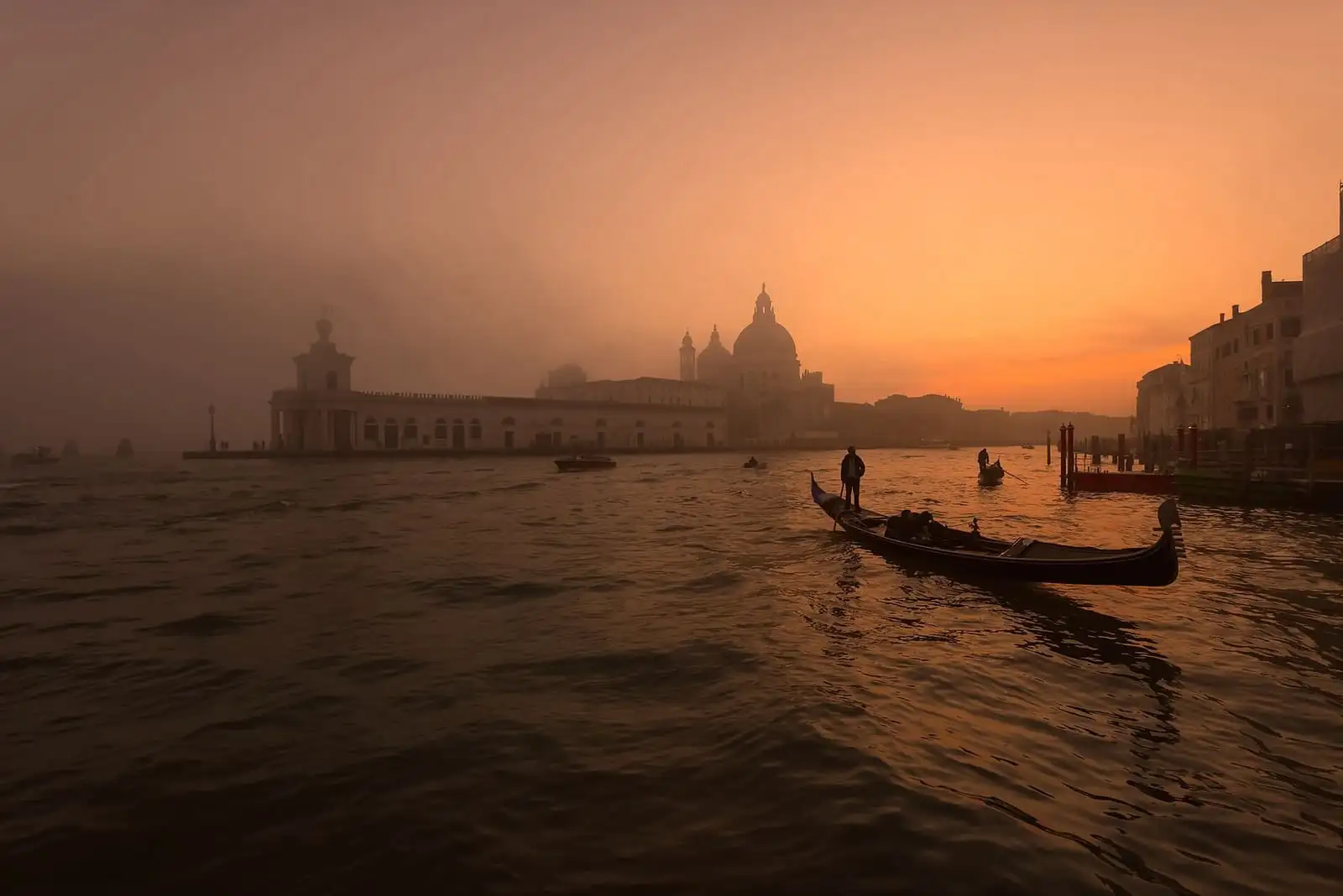

Punta della Dogana and the domes of Santa Maria della Salute, a few minutes' walk east of the Guggenheim.
- The Gallerie dell’Accademia holds the great collection of Venetian painting from the Middle Ages and the Renaissance; open Tuesday to Sunday 9am to 7pm, free under 18.
- Santa Maria della Salute is free to enter and, from November to March, opens 9:30am to 12:30pm and 3pm to 5:30pm, so go before lunch or late in the afternoon.
- Punta della DoganaMap, the old customs house at the tip of Dorsoduro, shows contemporary art from the Pinault Collection and opens only during exhibitions; the current one, Lorna Simpson’s Third Person, ends on 22 November 2026, and visitors under 20 go in free.
- The Galleria di Palazzo CiniMap, a house museum on Campo San Vio, opens only in a summer season (6 May to 27 September in 2026).
| Museum | Walk from the Guggenheim | Full price | With a Guggenheim ticket | Closed |
|---|---|---|---|---|
| Gallerie dell’Accademia | 5 minutes west, 400 m | €15 | €12 | Mondays |
| Santa Maria della Salute | 3 minutes east, 230 m | Free | Free | Middle of the day |
| Punta della Dogana | 5 minutes east, 350 m | €20 | €15 | Tuesdays and between exhibitions |
| Palazzo Cini | 2 minutes west, 170 m | See its site | €7 | Outside its summer season |
For a full day, see the Accademia in the morning, the Guggenheim after lunch and the Salute in the late afternoon, then walk out to the tip of the Punta della Dogana for the view of St. Mark’s across the water. If you want to sleep nearby, Dorsoduro is one of the calmer areas in our where to stay guide, and our things to do in Venice list puts the Guggenheim in context with the city’s other sights.
Frequently asked questions
How long do you need at the Peggy Guggenheim Collection?
Plan on 1.5 to 2 hours for the permanent collection, the garden and the canal terrace. Add 30 to 45 minutes if you also want the temporary exhibition and one of the free 15-minute talks.
Is Peggy Guggenheim buried in Venice?
Yes. Her ashes are in a corner of the garden of her former home, now the museum. A plaque next to her stone lists the 14 dogs buried beside her, under the words Here lie my beloved babies.
How much does the Peggy Guggenheim Collection cost?
A full ticket is €17 at the desk, or €18 online with the €1 booking fee. Visitors over 70 pay €14, students under 26 and ages 10 to 18 pay €9, and children under 10 go in free.
What day is the Peggy Guggenheim Collection closed?
Every Tuesday and on 25 December. On the other days it opens from 10am to 6pm, with last entry at 5pm.
Do I need to book Peggy Guggenheim tickets in advance?
You can buy at the door, but the museum advises booking a timed slot online. Online tickets cost €1 more, cannot be refunded, and late arrivals can be turned away.
Why is Peggy Guggenheim famous?
She was an American heiress who built one of the great collections of 20th-century art and ran the New York gallery Art of This Century, where Jackson Pollock had his first solo shows. She lived in Venice from 1949 until her death in 1979.
Is the Peggy Guggenheim Collection worth it?
Yes, if you want a break from Renaissance churches. It is a house-sized museum where you can see Picasso, Magritte, Kandinsky, Pollock and Brancusi in under two hours, with a sculpture garden and a terrace on the Grand Canal.