
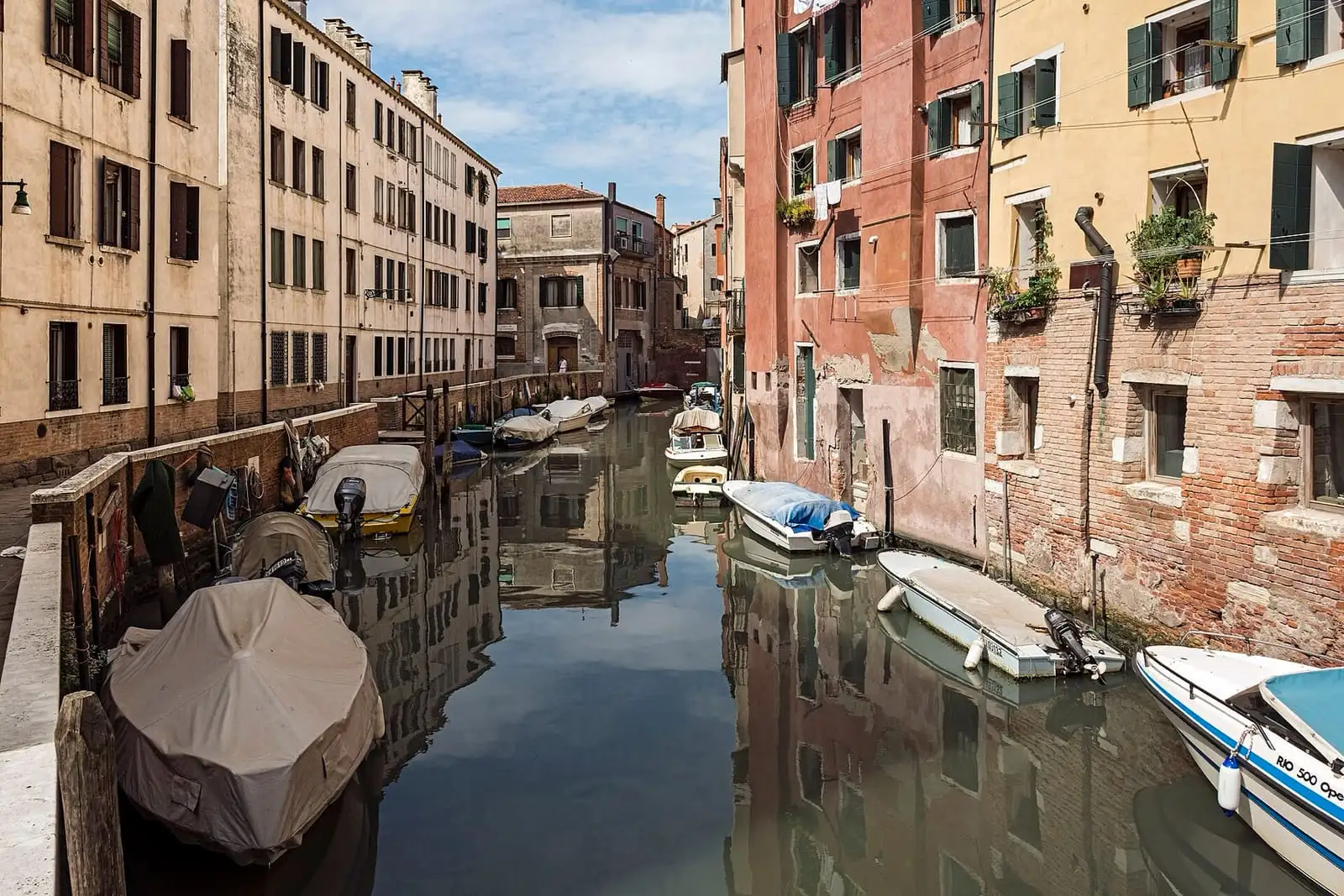
Quick answer
The Jewish Ghetto in Cannaregio, created in 1516, is free to visit and 11 minutes on foot from Santa Lucia station. To see inside, the Jewish Museum costs €18 and includes three of the five synagogues; it is closed on Saturdays and closes at 3pm on Fridays. For the stories behind the buildings, book a 2-hour guided walk with synagogue visits or a 1.5-hour synagogue tour.
Prices and times checked on 14 November 2026.
The Ghetto is the old Jewish quarter of Venice, a few calli and three squares in the northwest of Cannaregio. From 1516 to 1797 the Republic forced the city’s Jews to live here behind gates locked at night, and the word ghetto spread from here to the rest of the world. Today it is a quiet residential neighborhood and still the center of Jewish life in the city.
The Venetian Ghetto in short
On 29 March 1516 the Senate of the Republic ordered all Jews in Venice to live together in the Ghetto Nuovo, a small island near the church of San Girolamo, linked to the rest of the city by two bridges. About 700 German and Italian Jews moved in, paying rents a third higher than the going rate (the Jewish Museum’s history page tells the full story). Gates closed the island from evening to dawn, guarded around the clock by watchmen the Jews themselves had to pay, and in Venice Jews had to wear a yellow cap outside.
The name comes from the place itself. Before 1516 the island held the public foundries where the Republic cast its cannons, and the Venetian word for casting gave the area its name: getto, later ghetto. Scholars have proposed other origins, but this is the explanation the Jewish Community of Venice and most historians accept.
The quarter grew in three stages, and the names are confusing:
| Area | Since | Who lived there |
|---|---|---|
| Ghetto Nuovo (New Ghetto) | 1516 | German (Ashkenazi) and Italian Jews |
| Ghetto Vecchio (Old Ghetto) | 1541 | Levantine Jews, then Sephardic Jews from Spain and Portugal |
| Ghetto Nuovissimo (Newest Ghetto) | 1633 | Sephardic families who asked for more houses |
The New Ghetto is older than the Old Ghetto because the names refer to the new and old foundry sites, which existed before any Jew lived there.
French troops ended the Republic in 1797, the gates were torn down and the Jews of Venice became full citizens. A census that year counted 1,626 people in the Ghetto. When Austria took over a few months later, Jews had to live in the Ghetto again for a time, though with more rights than before. During the German occupation, 246 Venetian Jews were deported to the camps between 1943 and 1944.
Jewish Museum of Venice: tickets, hours and what is inside
The Jewish Museum of Venice (MEV)Map reopened in October 2026 after a long restoration and now covers more than 1,700 square meters around Campo del Ghetto Nuovo, with a new entrance, exhibition rooms, a library and a bookshop. The Italian name is Museo Ebraico, and the official sites call it MEV. The visit includes three synagogues on the museum route: the Scola Grande Tedesca and the Scola Canton, both German rite, and the Scola Italiana.
| What | Details |
|---|---|
| Address | Campo del Ghetto Nuovo, Cannaregio 2902/B |
| Hours, 1 to 15 November 2026 | Sunday to Thursday 10am to 5:30pm; Friday 9am to 3pm |
| Closed | Saturdays |
| Last entry | Arrive by 4pm (Sunday to Thursday) and by 1:30pm on Friday |
| Full ticket | €18 |
| Reduced | €14 for children from 6 and students up to 26; €11 for Venice residents |
| Free | Under 6, visitors with disabilities and one companion |
| Online booking fee | €2 |
| Included | The Tedesca, Canton and Italiana synagogues |
Buy at the ticket office in the square or online through the museum’s ticket seller. Hours are announced a few weeks at a time and change with the season, so check the official hours page the day before. On Jewish holidays, check before you go as well.
Book museum tickets on the official siteThe other two synagogues, the Levantine and the Spanish, stand outside the museum and open only on a private guided tour booked with the museum, by email at [email protected] or by phone at +39 041 5246083. On request the tour adds the women’s galleries, the Secret Garden behind the Spanish synagogue and the Midrash, a small study and prayer room. Ask a few days ahead, since there are no set times.
For more museums nearby and the city’s museum pass, see our Venice museums guide.
The five synagogues of the Ghetto
Each synagogue, called a scola, was built by a different community, and from the street most of them look like ordinary houses. On Campo del Ghetto Nuovo, only five white stone arches set the Scola Grande Tedesca apart from the houses around it.
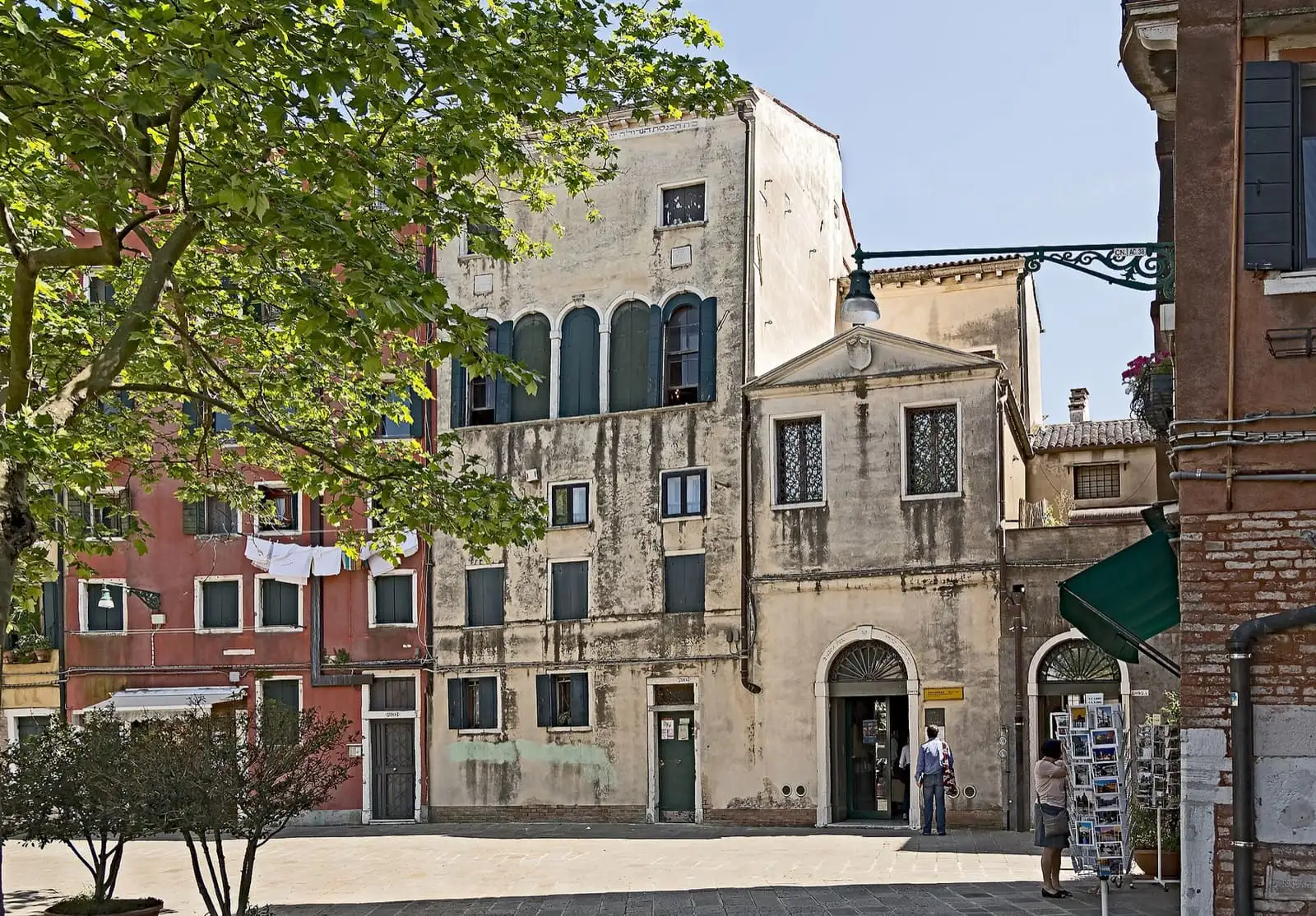

The facades of the Scola Grande Tedesca and the Scola Canton on Campo del Ghetto Nuovo.
| Synagogue | Rite | Built | How to see it |
|---|---|---|---|
| Scola Grande Tedesca | German (Ashkenazi) | From about 1528, the oldest in Venice | Museum ticket |
| Scola Canton | German (Ashkenazi) | 1531-1532 | Museum ticket |
| Scola Italiana | Italian | 1575, the last built under the Republic | Museum ticket |
| Scola Levantina | Sephardic, Levantine | 1538-1561, woodwork restored by the school of Andrea Brustolon | Private museum tour or a guided synagogue tour |
| Scola Spagnola | Sephardic, Spanish and Portuguese | The largest, rebuilt in the 17th century | Private museum tour or a guided synagogue tour |
The Levantine and Spanish synagogues are not museum rooms: the Community holds its Shabbat and holiday services in the Spanish synagogue in summer and in the Levantine in winter. Both stand in the Ghetto Vecchio, a short walk from the main square.
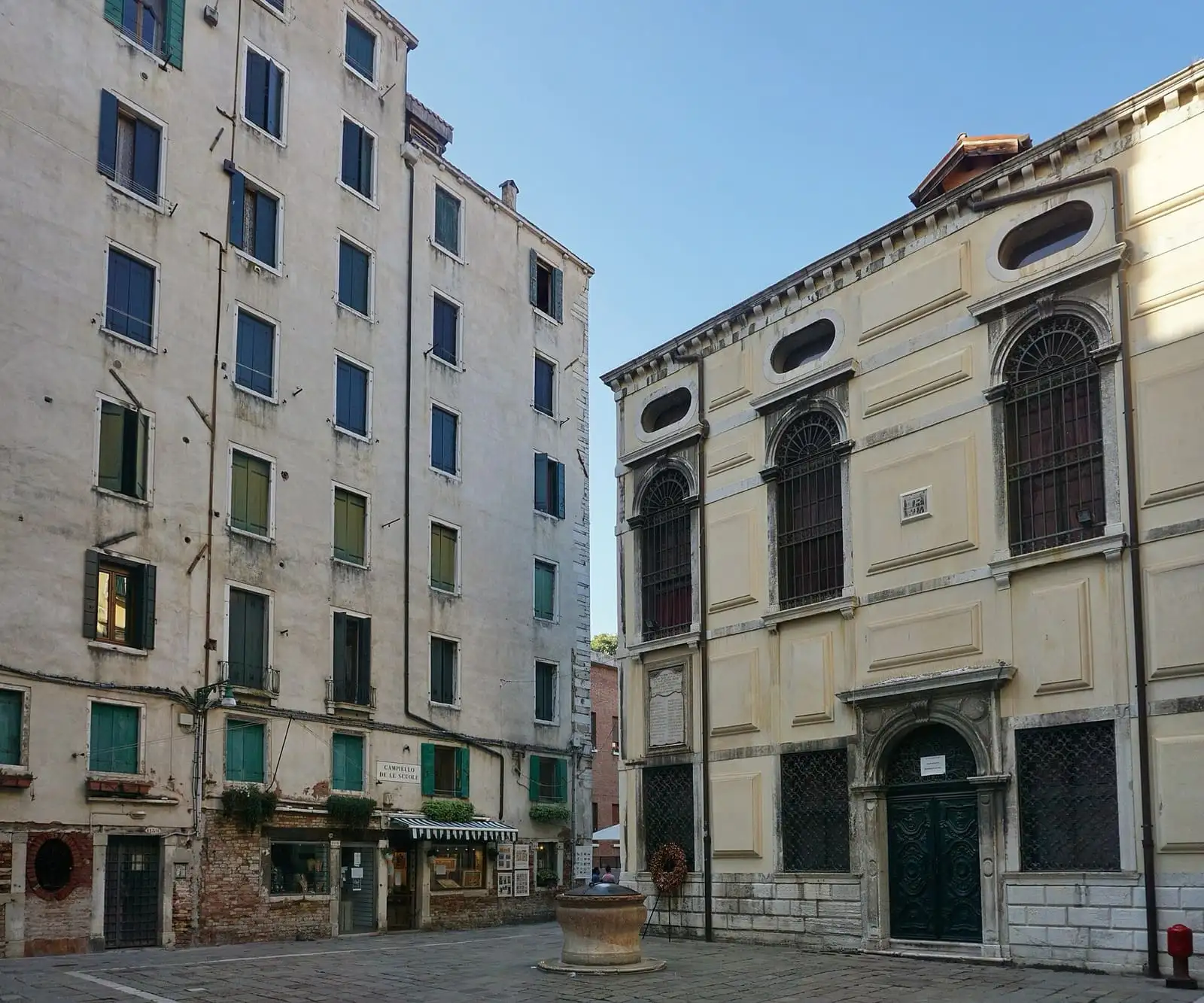

Campiello de le Scuole in the Ghetto Vecchio, with the Scola Levantina on the right.
Guided tours of the Jewish Ghetto
A guide makes the biggest difference here: the buildings are plain, and the history is in the details, the bank inscriptions, the walls and the stories of each community. Which synagogues a tour enters depends on the season, religious celebrations and the Community’s calendar.
| Tour | Length | Price | Synagogues | Meeting point |
|---|---|---|---|---|
| Jewish Ghetto walking tour with synagogue visits | 2 hours | From €89 | Visits arranged with the Jewish Museum; museum rooms not included | Campo del Ghetto Nuovo |
| Guided tour of synagogues with a local guide | 1.5 hours | €49, plus synagogue tickets bought at the start | Two synagogues | Campo del Ghetto Nuovo |
| Private tour of the Levantine and Spanish synagogues | On request | Ask the museum | Levantine and Spanish, on request women’s galleries and garden | Museum ticket office |
| Jewish Museum, self-guided | 1 to 1.5 hours | €18 | Tedesca, Canton, Italiana | Museum ticket office |
The 2-hour walk, run by Walks In Europe, has a 4.7 rating from 415 reviews and covers the Ghetto Nuovo and Ghetto Vecchio before the synagogue visit. The 1.5-hour tour by Hili has a 5.0 rating from 150 reviews; its guides are authorized by the Jewish Community to explain the synagogues, and several reviewers mention guides who live in the Ghetto. Both start in Campo del Ghetto Nuovo, both ask you to cover shoulders and knees, and both can be canceled free up to 24 hours ahead. The 2-hour walk is not suitable for wheelchair users. Book ahead, and do not plan either for a Saturday.
Book the Ghetto walking tourIf you want the Ghetto as part of a wider walk, or a free tour, our Venice walking tours guide compares the options, and the Eating Europe tour in our food tours guide includes a kosher main course in Cannaregio.
What to see in Campo del Ghetto Nuovo
Campo del Ghetto Nuovo, the main square, is free and open at all hours. Three of the five synagogues and the museum face it, so even a 20-minute walk through gives you the shape of the place.
- The Holocaust memorial. The bronze reliefs by the artist Arbit Blatas were installed here on 25 April 1980, Italy’s Liberation Day, and his sculpture The Last Train was dedicated in 1993, 50 years after the deportations. Next to them, a memorial lists the names of the 246 Venetian Jews deported in 1943 and 1944.
- The raids of 1943 and 1944. Most arrests came in early December 1943, starting with the raid of 5 December, and in the summer of 1944. Before that, on 17 September, the Community’s president, Giuseppe Jona, took his own life rather than hand over the list of members. In August 1944 the 21 residents of the old people’s home, including the old rabbi Adolfo Ottolenghi, were arrested and deported.
- The Red Bank. By the late 16th century three pawn banks worked on the square, called red, green and black after the color of their receipts. The only trace left is the inscription on the lintel of the Red Bank’s door. Whatever you may hear, the Italian expression for being in the red has nothing to do with it.
- The Chabad synagogue. Under the brick arches at Cannaregio 2915, Chabad of Venice holds a daily morning service at 8:30am, and visitors are welcome.
The Ghetto is a quiet residential area; for pickpockets, crowds and late evenings in the rest of the city, see our guide to whether Venice is safe.
How to get to the Jewish Ghetto
The Ghetto is in the northwest of Cannaregio, between the train station and the Strada Nova. The main entrance is a covered passage, the sottoportego of Calle del Ghetto Vecchio, on the Fondamenta di Cannaregio, a minute’s walk along the canal from the Ponte delle Guglie.
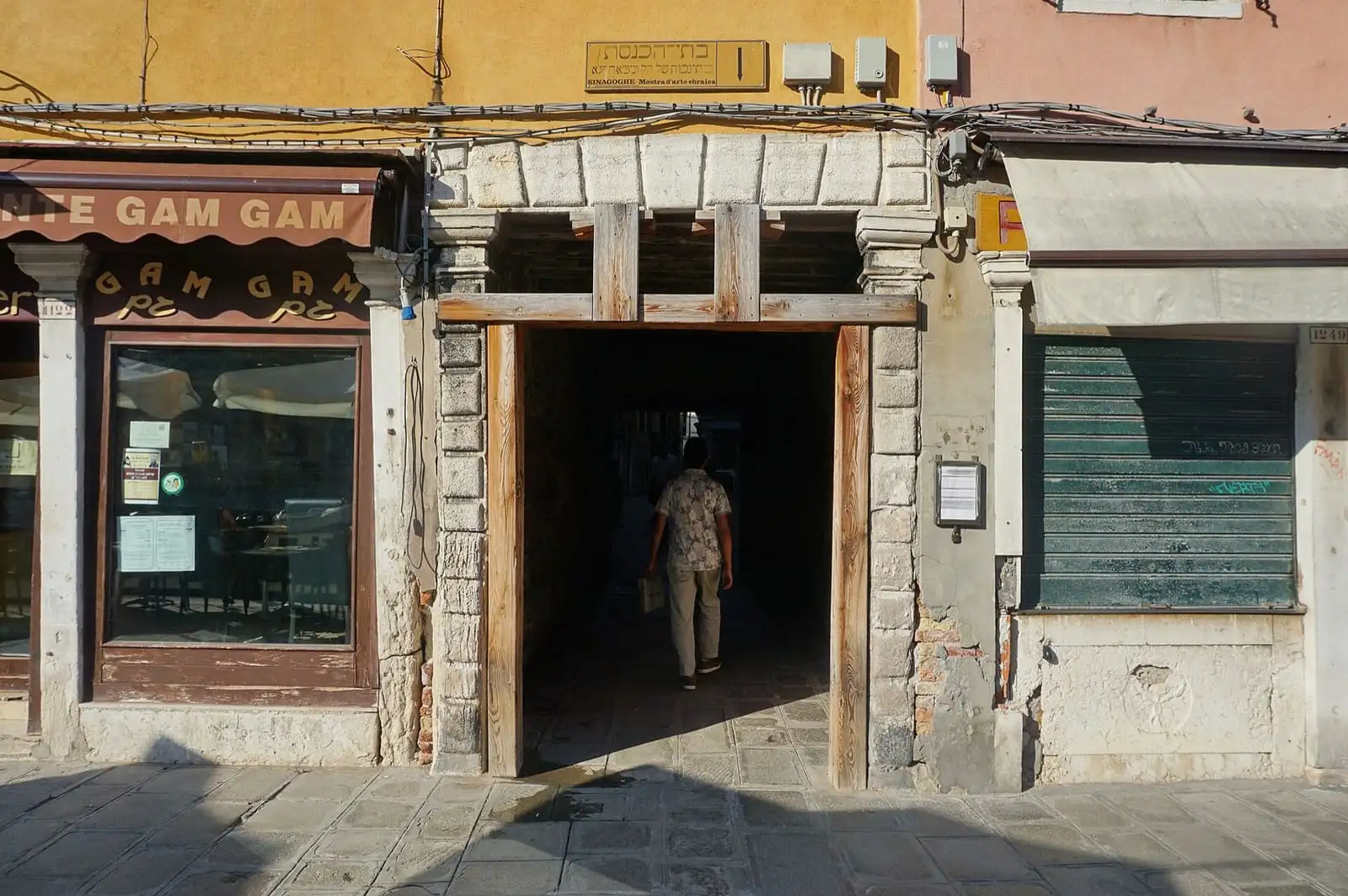

The covered entrance to Calle del Ghetto Vecchio from the Fondamenta di Cannaregio.
| From | On foot | By vaporetto |
|---|---|---|
| Santa Lucia train station | 11 min, 800 m, along Lista di Spagna | Not worth it |
| Ponte delle Guglie | 4 min, 300 m | Guglie stop: lines 4.1, 4.2, 5.1, 5.2 |
| San Marcuola stop | 6 min, 450 m | Lines 1 and 2 on the Grand Canal |
| Rialto Bridge | 20 min, 1.4 km, along the Strada Nova | Line 1 to San Marcuola |
| St. Mark’s Square | 25 min, 1.8 km, along the Strada Nova | Line 1 to San Marcuola |
Walking times are from Google Maps, without stops. A single vaporetto ticket costs €9.50 for 75 minutes, so from the station or the Rialto walking is the easy choice. From St. Mark’s, line 1 up the Grand Canal is a pleasant way to arrive; our vaporetto guide explains tickets and passes, and our Venice map guide shows where the Ghetto sits among the sestieri.
Kosher food and Chabad of Venice
Three kosher places to eat stand a few minutes apart in the Ghetto.
GAM GAM Kosher RestaurantMap is run by Chabad of Venice at the main entrance of the Ghetto, on the Cannaregio canal by the Ponte delle Guglie, five minutes on foot from the station. It is glatt kosher (meat) under Lubavitch supervision and bakes its own bread and pastries every day. It is also the Shabbat kitchen for travelers: you can reserve all three Shabbat meals at a private table, order a Shabbat takeaway until three hours before Shabbat, or have meals delivered to your hotel if you order and pay by Thursday. Delivery in Venice goes by private boat and costs extra, around €70 to San Marco. If you arrive on a Friday after 2pm, call the restaurant to place your order.
gam gam goodiesMap, a few steps away, is the dairy and parve side: coffee, breakfast all day, pizza, sandwiches, cakes and kosher ice cream. It opens Sunday to Thursday from 7am to 8pm, and on Friday from 7am until an hour before Shabbat.
Ba'Ghetto VeneziaMap, at Cannaregio 2873/c on Campo del Ghetto Nuovo, is a sit-down restaurant with Roman Jewish and Middle Eastern cooking, kosher under the supervision of the Jewish Community of Venice. It serves no dairy and no shellfish. The rooms look onto the square on one side and the canal on the other, and there is a large garden for warm evenings. It opens for lunch and dinner Sunday to Thursday, for lunch only on Friday, and on Saturday from 7pm, after Shabbat.
Regular supermarkets in Venice carry very few kosher products, and their bread, milk and gelato are not kosher.
Visiting on Shabbat and with respect
The Ghetto is a living neighborhood with working synagogues, and a few rules make the visit easier for you and for the people who live there.
- Saturday is the wrong day for sightseeing. The museum is closed, guided tours do not run and the synagogues are open only for services. Come Sunday to Thursday, or Friday morning.
- Dress for a place of worship. Tours ask men and women to cover shoulders and knees inside the synagogues; some also ask for the belly to be covered.
- Services need a reservation. To attend Shabbat or holiday services with the Jewish Community, you reserve ahead and send a scan of a valid ID or passport for every family member; the Community’s religious services page has the details. Chabad of Venice publishes its own Shabbat schedule and meal reservations.
- The eruv covers most of the city. Chabad advises observant travelers to stay between the train station and the Rialto Bridge, on the same side of the Grand Canal as the Ghetto. During acqua alta, when canals and streets merge, the eruv is not valid.
- No luggage storage in the synagogues. Chabad cannot keep bags; use the paid left luggage at the station, described in our train station guide.
To sleep inside that area, our guide to where to stay in Venice compares Cannaregio with the other neighborhoods.
See hotels in CannaregioThe Jewish cemetery on the Lido
The Jewish history of Venice is older than the Ghetto. In 1386 the Republic gave the Jews a plot of land at San Nicolò on the Lido for a cemetery, more than a century before the 1516 decree. After centuries of damage and neglect, restoration began in 1999, and more than 1,000 gravestones dating from 1550 to the early 18th century have been saved and catalogued.
The ancient Jewish cemetery of the LidoMap can be visited only on a guided tour, booked through the Jewish Museum. The Lido is a vaporetto ride from the city; our Lido guide covers boats, beaches and what else to see on the island.
How long to spend in the Ghetto
Give it 20 to 30 minutes to walk the three squares, 1 to 1.5 hours with the museum, or 2 hours with a guided tour. It fits well at the start or end of a day, since the station is 11 minutes away, and it pairs with an evening of cicchetti along the Cannaregio canals; our cicchetti guide lists the bars. For more sights to combine with it, see the best things to do in Venice.
Frequently asked questions
Is the Jewish Ghetto in Venice worth visiting?
Yes. It is the place that gave the world the word ghetto, it still has five historic synagogues and the reopened Jewish Museum, and it is one of the quietest corners of Venice. The squares are free; plan 1.5 to 2 hours if you add the museum or a tour.
Why is it called the Jewish Ghetto?
Before 1516 the area held the city's public foundries, where cannons were cast, and the Venetian word for casting gave the place its name, getto or ghetto. When the Senate confined the Jews there in 1516, the name of the place became the word for any enforced Jewish quarter.
Does the Venetian Ghetto still exist?
Yes. The gates came down in 1797, but the Ghetto is still the center of the Jewish Community of Venice, about 450 people, with its synagogues, offices, library, kosher restaurants and a Chabad synagogue. Few members actually live inside it today.
Why did Jews go to Venice?
For trade and for safety. After 1513 Venice let Jewish lenders and merchants live in the city for an annual payment, Levantine merchants were welcome for their trade with the Ottoman world, and Sephardic Jews expelled from Spain and Portugal in 1492 found refuge there.
Is the Jewish Museum of Venice open on Saturday?
No. The museum is closed on Saturdays, and on Fridays it closes at 3pm. In the first half of November 2026 it opens Sunday to Thursday from 10am to 5:30pm; hours change with the season, so check the official hours page before you go.
How much does it cost to visit the Jewish Ghetto?
Walking around the Ghetto is free. The Jewish Museum costs €18, or €14 for children from 6 and students up to 26, plus €2 if you book online, and the ticket includes three synagogues. Guided tours start at €49.
How do I get to the Jewish Ghetto from the train station?
Walk. Campo del Ghetto Nuovo is 11 minutes and 800 meters from Santa Lucia station along Lista di Spagna, over the Ponte delle Guglie. By vaporetto, lines 4.1, 4.2, 5.1 and 5.2 stop at Guglie, 4 minutes from the square.